


Summarize Blog
Quick Summary
This blog post covers software testing governance, its key components, implementation steps, scaling practices, QA metrics, common mistakes, and how Jira test management tools support traceability and reporting.
When multiple teams follow different testing practices, maintaining consistent software quality becomes difficult. Test coverage varies across projects, release risks go unnoticed, and QA leaders struggle to get a clear view of testing progress. Without shared testing policies, standards, and controls, teams may also find it difficult to demonstrate compliance or make informed release decisions.
Software testing governance establishes the policies, roles, standards, and controls that guide how an organization plans, executes, monitors, and improves software testing. It helps teams follow consistent quality expectations while adapting their test processes to different products, risks, and delivery requirements.
A scalable QA governance framework gives organizations a structured way to manage testing across teams. This guide explains its key components, how to build and scale a framework, which KPIs to track, and how Jira test management tools can support traceability, test reporting, and consistent QA practices.
What Is Software Testing Governance?
Software testing governance is the set of policies, standards, roles, controls, and measurement practices that guide how an organization plans, performs, monitors, and improves software testing. It ensures that testing aligns with business objectives, product risks, and defined quality expectations.
A software testing governance framework establishes how teams should approach testing, who is responsible for quality decisions, and how testing outcomes are measured. It also helps QA leaders identify gaps, maintain visibility across projects, and assess whether teams meet agreed testing standards.
The main objectives of QA governance include:
- Consistency: Establish shared testing policies and standards across teams and projects.
- Accountability: Define ownership of test planning, execution, defect resolution, and release decisions.
- Risk management: Direct testing effort toward features and systems where failures could have the greatest impact.
- Visibility: Track test coverage, execution results, defects, and release readiness through clear reporting.
- Compliance: Maintain testing records and evidence needed to demonstrate adherence to applicable requirements.
How Does Test Governance Differ From Test Management and Test Execution?
These three activities serve different purposes within a quality assurance framework.
For example, governance may require critical business workflows to pass defined quality gates before release. Test management determines the test plan, schedule, and resources needed to meet those requirements. Test execution verifies the workflows and records whether they pass or fail.
Together, these activities help organizations apply software testing standards consistently while keeping testing aligned with product risks and release objectives.
Why Is a QA Governance Framework Important?
A QA governance framework helps organizations maintain consistent testing practices as their products, teams, and release cycles grow. Without shared standards and clear accountability, teams may measure quality differently, overlook critical risks, or struggle to explain whether a release meets expectations.
Here are five reasons software testing governance matters.
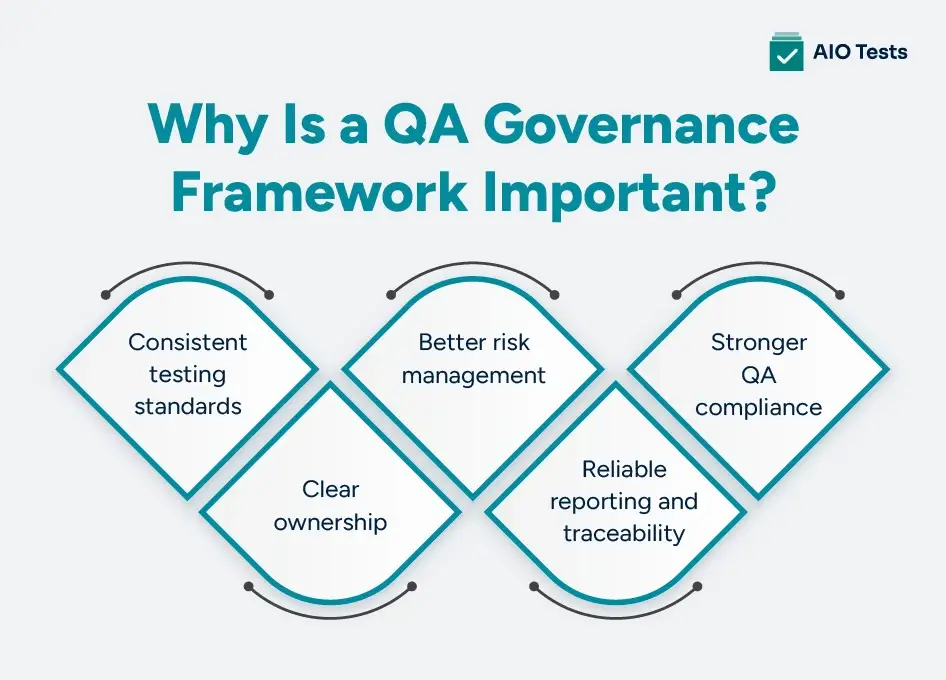
- Consistent testing standards: Shared policies and test processes help teams follow common expectations for test planning, execution, documentation, and defect handling.
- Clear ownership: Defined roles establish who manages testing activities, resolves defects, accepts residual risks, and approves releases.
- Better risk management: Risk-based testing helps teams focus on critical features and apply appropriate testing controls before release.
- Reliable reporting and traceability: Connecting requirements, test cases, results, and defects gives stakeholders a clearer view of test coverage and release readiness.
- Stronger QA compliance: Documented testing practices and accessible evidence help organizations demonstrate that required controls and procedures were followed.
A governance framework also makes it easier to compare quality metrics across projects and identify recurring problems. For example, if multiple teams report high test pass rates but continue to release defects, QA leaders can investigate gaps in coverage, test design, or release criteria.
The goal is not to make every team follow an identical testing process. It is to establish shared quality expectations and give teams the flexibility to meet them based on their product's complexity, business impact, and risk level.
What Are the Key Components of a Test Governance Framework?
A test governance framework brings together the policies, responsibilities, processes, and controls an organization uses to manage software quality. Each component serves a specific purpose, from defining testing expectations to measuring results and improving practices across teams.
The following eight components form a practical foundation for a scalable QA governance framework.
What Should Testing Policies and Standards Include?
Testing policies establish the organization's overall expectations for quality, while testing standards explain how teams should meet those expectations. Together, they provide a consistent foundation for test processes without prescribing every task in detail.
Depending on the organization's needs, they may cover:
- Test planning, design, execution, and completion criteria.
- Test case documentation, requirement traceability, and defect reporting.
- Risk assessment, regression testing, and automation guidelines.
- Quality gates, reporting requirements, and release approval rules.
- Test evidence retention, access permissions, and applicable QA compliance requirements.
These requirements should reflect the product's risk level and any relevant contractual, regulatory, or industry obligations.
How Do Quality Gates and Testing Controls Work?
Quality gates are specific checkpoints used to determine whether defined release or testing criteria have been met. Testing controls are the broader procedures used to manage quality risks, such as mandatory reviews, defect severity rules, access restrictions, and approval workflows.
For example, a team releasing a payment feature might require all critical test cases to pass, prohibit unresolved critical defects, and obtain approval for any accepted residual risk. A lower-risk change may require fewer checks.
The organization should document each gate's criteria, owner, evidence requirements, and exception process. This makes release decisions more consistent and easier to review.
A strong framework connects these components rather than treating them as separate policies. Standards define expectations, roles establish accountability, test processes put those expectations into practice, and quality metrics show whether the framework is working.
How Do You Build a Software Testing Governance Framework?
Building a software testing governance framework starts with understanding existing QA practices and identifying what needs to change. The goal is to establish clear standards, assign ownership, and introduce controls that teams can follow without creating unnecessary work.
Follow these eight steps to build a framework that can scale across projects and teams.
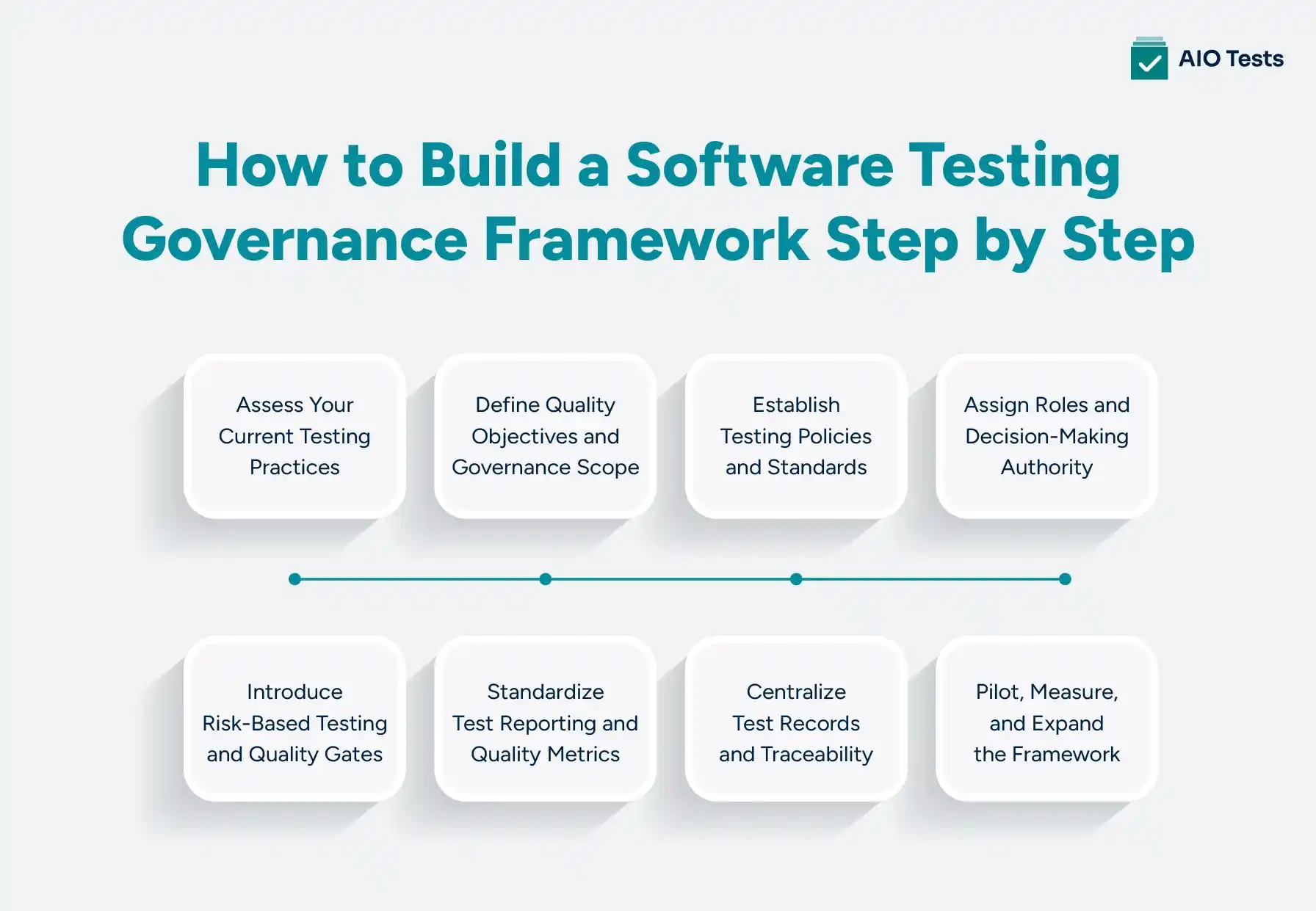
Step 1: Assess Your Current Testing Practices
Start by reviewing how teams plan, execute, document, and report testing. Identify gaps between existing practices and the quality expectations your organization needs to meet.
- Review current testing policies, standards, workflows, and tools.
- Identify gaps in test coverage, accountability, traceability, and QA compliance.
- Check for duplicated effort, inconsistent reporting, and recurring defects.
- Record baseline quality metrics to measure future progress.
This assessment helps you prioritize governance changes based on actual problems rather than introducing rules that teams may not need.
Step 2: Define Quality Objectives and Governance Scope
Set clear objectives before introducing new testing controls. These objectives should reflect business priorities, product risks, customer expectations, and release requirements.
- Decide which teams, applications, projects, and release stages the framework covers.
- Define the minimum quality expectations that apply across the organization.
- Identify risks that require additional testing or approval.
- Separate mandatory controls from practices teams can adapt to their workflows.
For example, a financial application may need stricter release criteria and traceability than an internal tool with limited business impact.
Step 3: Establish Testing Policies and Standards
Document the rules teams must follow and the standards they should use when managing software quality. Keep the policies specific enough to guide decisions without dictating every testing activity.
- Define expectations for test planning, test design, execution, and defect reporting.
- Establish standards for test case documentation and requirement traceability.
- Set guidelines for test data, test environment, regression testing, and automation where relevant.
- Document how teams request, approve, and record exceptions.
Review these policies periodically to ensure they remain relevant to the organization's products and delivery practices.
Step 4: Assign Roles and Decision-Making Authority
A governance framework needs clear ownership. Teams should know who defines testing standards, who carries out testing, and who makes decisions when quality requirements are not met.
- Assign responsibility for test strategy, test execution, and defect resolution.
- Define who reviews testing results and approves release readiness.
- Clarify who can accept residual risks and authorize exceptions.
- Establish escalation paths for unresolved defects and failed quality gates.
Clear accountability prevents critical quality decisions from being delayed or left to individual interpretation.
Step 5: Introduce Risk-Based Testing and Quality Gates
Not every feature needs the same level of testing. Risk-based testing helps teams allocate effort according to the likelihood and impact of failure, while quality gates establish measurable conditions for proceeding.
- Assess risks based on business impact, technical complexity, and failure likelihood.
- Prioritize testing for critical workflows, security-sensitive features, and important integrations.
- Define entry criteria, exit criteria, and release conditions.
- Specify what happens when a quality gate fails, including how exceptions are approved.
For example, a payment-processing change may require additional integration and regression testing before release. A minor visual change may need a narrower set of checks.
Step 6: Standardize Test Reporting and Quality Metrics
QA leaders need consistent information to compare results across teams and identify quality risks. Standardized test reporting makes that information easier to interpret.
- Select common quality metrics, such as risk coverage, escaped defects, and execution progress.
- Define each metric, its data source, its owner, and its review frequency.
- Report unresolved high-severity defects, failed tests, and outstanding release criteria.
- Use a shared reporting structure while allowing additional metrics for specific products.
Avoid measuring performance through test pass rates alone. Combine execution data with defect trends, risk coverage, and release outcomes to understand whether testing is effective.
Step 7: Centralize Test Records and Traceability
Testing evidence is easier to review when requirements, test cases, execution results, and defects are connected. A shared system of record also reduces the need to reconcile reports from multiple sources.
- Link test cases to relevant requirements and identified risks.
- Record execution results, defects, and supporting evidence.
- Define how testing records are stored, accessed, and retained.
- Make test reports available to the people responsible for quality reviews and release decisions.
Teams working in Jira can use a test management tool to organize test cases, manage execution cycles, connect testing activities, and report results within their existing workflows.
Step 8: Pilot, Measure, and Expand the Framework
Avoid rolling out a new governance framework across every team before testing how it works in practice. A pilot helps identify unclear policies, unnecessary controls, and reporting gaps.
- Introduce the framework to one product team or project.
- Gather feedback on policies, quality gates, and reporting requirements.
- Compare results with the baseline established during the initial assessment.
- Refine the framework before expanding it to other teams.
- Schedule regular reviews to address changing risks and recurring problems.
Measure success through better risk visibility, stronger traceability, consistent application of required controls, and more informed release decisions. The framework should evolve as the organization grows, not remain a fixed set of rules.
How Do You Scale QA Governance Across Multiple Teams?
Scaling QA governance requires a balance between organization-wide standards and team-level flexibility. Every team should follow the same core quality expectations, but testing methods and controls can vary according to product complexity, delivery needs, and business risk.
A scalable QA governance framework should focus on six practices:
- Set shared minimum standards: Define common expectations for test documentation, defect severity, traceability, and release readiness. Let teams choose the testing methods that suit their projects.
- Use consistent quality metrics: Establish shared definitions for test coverage, escaped defects, execution progress, and release failures so QA leaders can compare results across teams.
- Apply controls according to risk: Require more rigorous testing and review for critical systems, sensitive data, and high-impact changes. Avoid imposing the same level of control on every release.
- Standardize reporting: Give stakeholders a consistent view of testing progress, unresolved defects, and release risks without requiring every team to use identical workflows.
- Automate repetitive tasks: Use test management tools and automation integrations to reduce manual reporting, maintain traceability, and collect execution results.
- Review exceptions centrally: Track deviations from testing policies, identify recurring problems, and update standards when evidence shows that a control is ineffective or unnecessary.
A Three-Level Model for QA Governance
Organizations can distribute governance responsibilities across three levels to maintain oversight without centralizing every testing decision.
For example, the organization may require risk-based testing for every critical release. A product team then identifies its highest-risk workflows and defines suitable test coverage, while the delivery team executes the tests and records evidence before release approval.
This model helps QA leaders maintain consistent oversight while allowing teams to adapt their test processes to local needs. As the organization grows, shared reporting, clear ownership, and proportionate testing controls help governance scale without adding unnecessary approval steps.
When Should You Establish a TCoE?
A Test Center of Excellence (TCoE) is a centralized or federated function that coordinates testing standards, tools, expertise, and best practices across an organization. It helps teams follow consistent quality expectations while improving how they plan, execute, and measure testing.
A TCoE can support QA governance by:
- Defining testing standards: Establish shared guidelines for test processes, documentation, automation, and quality reporting.
- Sharing expertise: Provide teams with reusable testing practices, templates, training, and specialist knowledge.
- Supporting test automation: Recommend frameworks, integration approaches, and practices that teams can reuse.
- Monitoring quality metrics: Review testing performance across projects and identify recurring defects, coverage gaps, and process issues.
- Driving continuous improvement: Use testing results and team feedback to refine standards and address common challenges.
Centralized vs. Federated TCoE Models
Organizations can structure a TCoE in different ways, depending on their size, delivery model, and governance needs.
When Should You Establish a TCoE?
A TCoE may be useful when an organization has multiple product teams, duplicated testing effort, inconsistent software testing standards, or a need for stronger oversight across complex projects. It can also help organizations coordinate specialized testing capabilities and support applicable compliance requirements.
However, a TCoE is not essential for every organization. Smaller teams may manage QA governance through existing QA leadership, provided responsibilities, standards, and reporting requirements are clear.
The key is to choose a structure that supports collaboration and accountability without creating unnecessary bureaucracy. A TCoE should help teams apply the QA governance framework effectively, not become another approval layer that slows delivery.
Which KPIs Measure the Effectiveness of QA Governance?
QA governance KPIs help organizations assess whether testing policies are being followed, quality risks are visible, and release decisions are based on reliable evidence. These quality metrics should measure both testing outcomes and how effectively teams apply the agreed governance controls.
Here are nine KPIs to consider in a software testing governance framework.
How Should You Track QA Governance KPIs?
To make these metrics useful, define how each one is calculated and how the results will inform decisions.
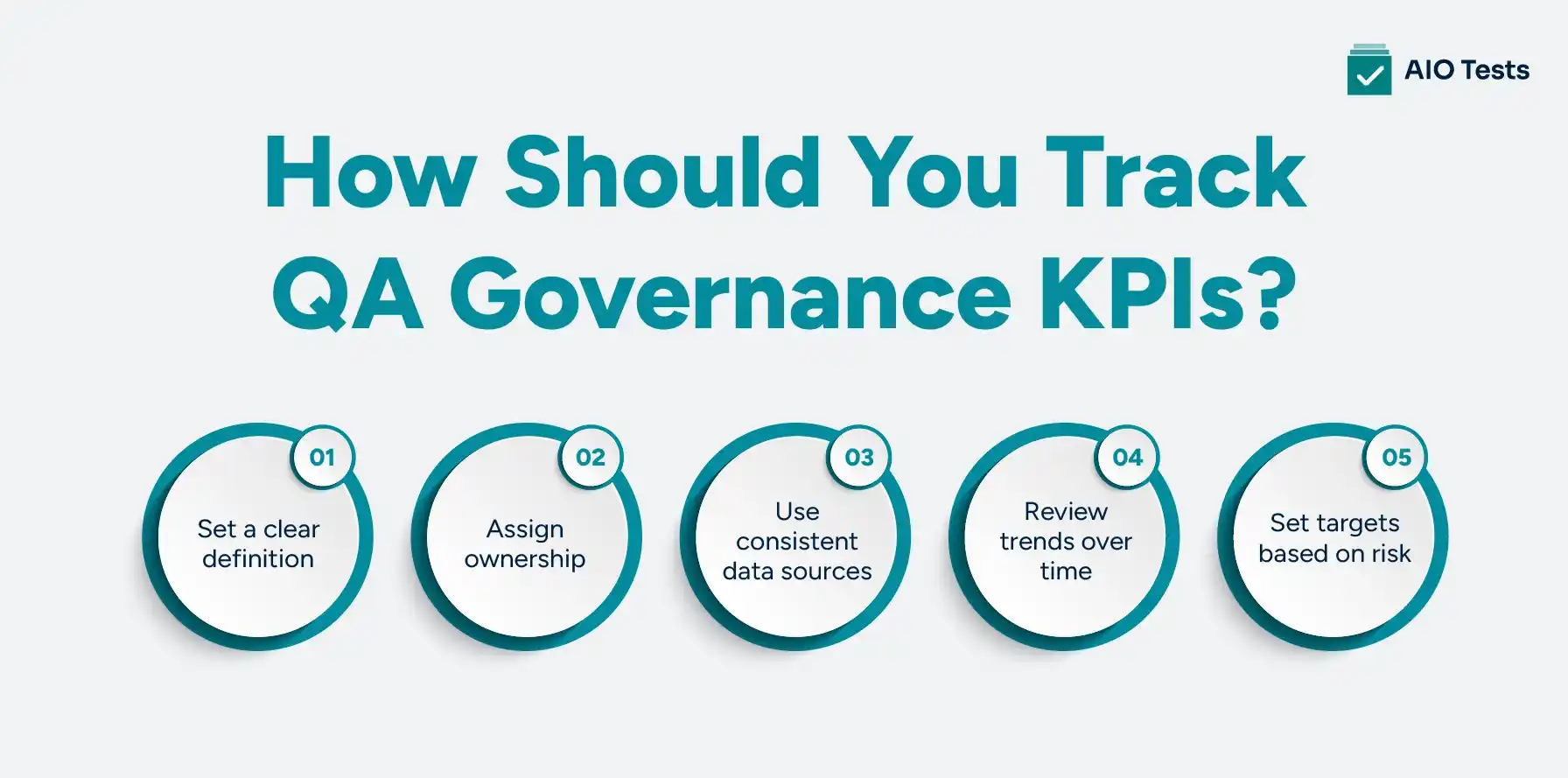
- Set a clear definition: Agree on what counts as a covered requirement, escaped defect, failed quality gate, or governance exception.
- Assign ownership: Identify who collects, validates, reviews, and acts on each metric.
- Use consistent data sources: Collect testing results and defect information from systems teams can access and maintain.
- Review trends over time: Compare results across releases and periods instead of judging performance from a single report.
- Set targets based on risk: Establish targets that reflect product criticality, customer impact, and delivery requirements rather than applying arbitrary benchmarks.
For example, a high test pass rate may look positive, but it does not show whether critical requirements were tested or whether important defects escaped into production. Reviewing pass rates alongside risk coverage, escaped defects, and quality-gate compliance gives QA leaders a more complete view.
Tools that support test reporting and traceability can make these reviews easier by bringing execution results and related testing records together. The aim is to use quality metrics to identify gaps and guide improvement, not to reward teams for meeting numbers without examining the underlying results.
How Can Jira Test Management Tools Support Software Testing Governance?
A software testing governance framework works only when teams can apply its policies and record their testing outcomes consistently. When test cases, execution results, defects, and reports are spread across different tools, QA leaders may struggle to verify coverage, track progress, and assess release readiness.
For teams that use Jira, a test management tool can bring these activities into a shared workflow.
How Test Management Supports QA Governance
- Test case management: Organize reusable test cases and maintain consistent documentation across projects.
- Test execution tracking: Record test results, monitor execution progress, and identify failed tests that need attention.
- End-to-end traceability: Link requirements, test cases, execution cycles, and defects to make testing coverage easier to review.
- Test reporting: Give QA leaders visibility into execution status, coverage, and testing outcomes.
- Automation integration: Bring automated test results into test management workflows to support consistent reporting across manual and automated testing.
- Testing evidence: Maintain accessible test records that support quality reviews and release decisions.
AIO Tests and Atlassian Government Cloud
AIO Tests best Jira test management tool, has achieved certification for Atlassian Government Cloud (AGC), which makes it a relevant option for teams evaluating Jira test management tools for government cloud environments.
The tool helps teams manage test cases, track execution results, and maintain traceability within Jira. These capabilities support organized testing records and reporting, while teams remain responsible for meeting their applicable governance, security, and compliance requirements.
What Are the Common Mistakes to Avoid in QA Governance?
A QA governance framework should make testing expectations clear and quality risks easier to manage. However, poorly designed governance can add unnecessary work without improving software quality.
Avoid these common mistakes when building or scaling your framework.
- Creating vague testing policies: Broad guidelines leave teams unsure about required testing activities. Define clear standards, responsibilities, and acceptance criteria.
- Applying identical controls to every project: Different applications carry different risks. Adjust testing depth and oversight according to business impact and failure likelihood.
- Measuring activity instead of outcomes: High test execution counts or pass rates do not guarantee adequate coverage. Review defect trends, risk coverage, and release outcomes alongside execution metrics.
- Making reporting a formality: Collecting quality metrics adds little value if teams do not use them to identify risks or make decisions. Assign owners and define how reports should inform action.
- Centralizing every decision: Requiring central approval for routine testing decisions can delay delivery. Set organization-wide standards while giving teams appropriate authority to execute tests and resolve issues.
- Neglecting traceability and evidence: Missing links between requirements, test cases, results, and defects make reviews harder. Define what evidence teams must maintain and how it should be accessed.
- Treating governance as a one-time exercise: Products, risks, and delivery practices change over time. Review policies, testing controls, and quality metrics regularly to identify gaps and remove outdated requirements.
Effective software testing governance is not about adding more rules. It is about establishing controls that address real risks, making accountability clear, and using reliable testing information to support release decisions. Review the framework regularly to ensure it continues to serve these goals without slowing teams down unnecessarily.
Conclusion
Software testing governance gives organizations a structured way to manage testing policies, standards, responsibilities, and quality controls across teams. A scalable QA governance framework combines risk-based testing, clear quality gates, reliable test reporting, and measurable KPIs to help teams identify risks and make informed release decisions.
Start by assessing existing test processes, defining shared standards, and assigning clear ownership. Then introduce controls based on product risk, track relevant quality metrics, and refine the framework as your organization grows. The aim is to maintain consistent quality expectations without restricting how teams work.
For teams managing testing in Jira, AIO Tests can support this approach through test case management, execution tracking, traceability, and reporting. These capabilities help teams maintain testing records and monitor progress while QA leaders remain responsible for governance policies and release criteria.

FAQs
1. What is software testing governance?
Software testing governance is the set of policies, standards, roles, and controls that guide testing across an organization. It establishes consistent quality expectations, defines accountability, and helps teams manage risks, track testing outcomes, and make informed release decisions.
2. What are the key components of a test governance framework?
The key components include testing policies and standards, defined roles and responsibilities, standardized test processes, risk management, quality gates, quality metrics, test reporting, traceability, and continuous improvement. Together, these components help teams follow consistent testing practices while adapting to their products' risks and requirements.
3. What is the difference between test governance and test management?
Test governance defines the policies, standards, controls, and accountability that guide testing across an organization. Test management focuses on planning, coordinating, monitoring, and reporting testing activities within those guidelines. Governance sets the expectations, and test management helps teams meet them.
4. What is a Test Center of Excellence (TCoE)?
A Test Center of Excellence (TCoE) is a centralized or federated function that coordinates testing standards, tools, expertise, and best practices across teams. It can support automation, establish shared processes, and monitor quality metrics. Organizations can choose a centralized or federated model based on their size and needs.
5. Which KPIs measure QA governance?
Common QA governance KPIs include requirements and risk coverage, escaped defect rate, quality-gate compliance, test traceability, governance exception rate, and release failure rate. Teams should define each metric consistently and review trends over time. Using multiple KPIs provides a more complete view than relying on test pass rates alone.


.svg)
