








%201.webp)
Health systems, payers, and certification bodies ask what was tested, against which version, and by whom. Spreadsheets and disconnected tools make that record slow to produce and hard to defend.
HL7 and FHIR interfaces, lab and pharmacy systems, e-prescribing networks, provincial and national health services. Every release has to prove those paths still work, and they change on someone else's schedule, not yours.
Eligibility rules, coverage types, coding combinations, and patient variables multiply fast. Copying data down from production isn't an option, so teams work from limited curated datasets and either maintain dozens of near-identical test cases or quietly under-test the edge cases.
Implementation leads, clinical product owners, and compliance teams need current testing status. When reporting is manual, the picture they're working from is always a few days behind the real one.
Healthcare vendors rarely ship one product. Without shared test structures and reusable suites, each product line develops its own QA practice, and portfolio-level coverage becomes impossible to verify.
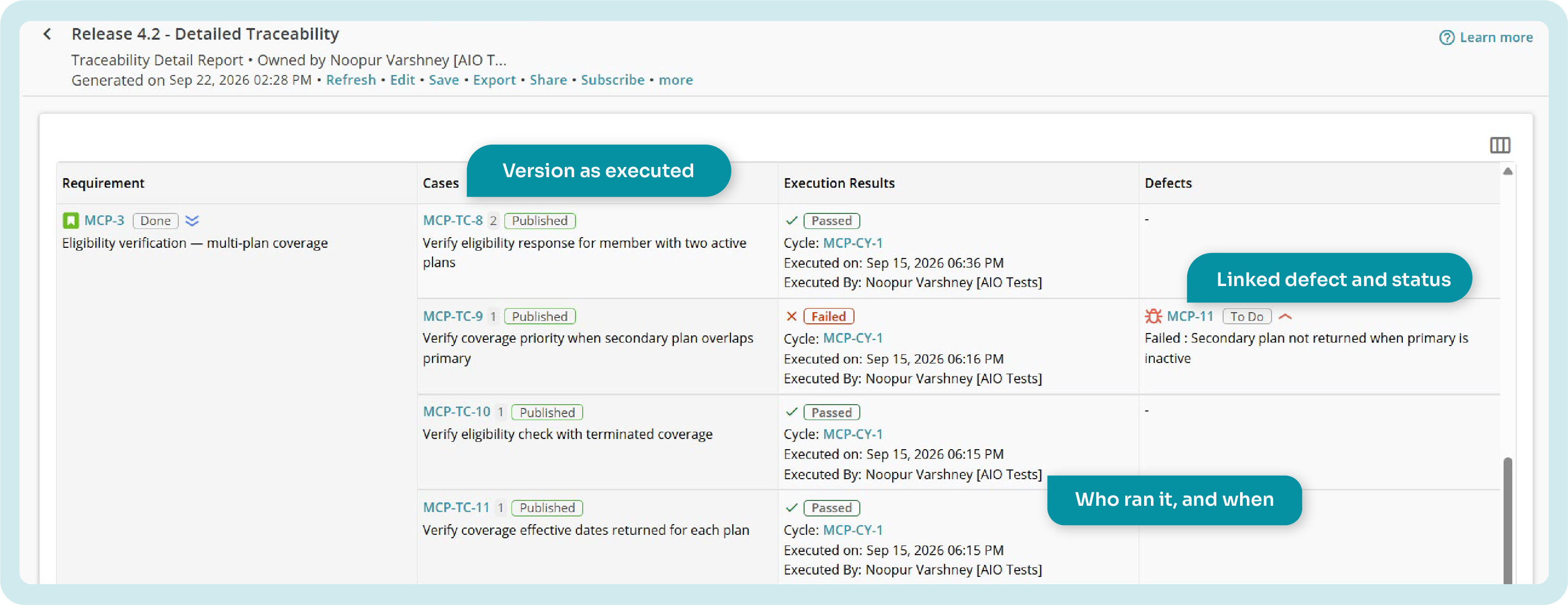
Every requirement, the cases that cover it, the version executed, and the defects raised - generated on demand, scoped to whatever you need to report on.
.webp)
From companies like Apollo Health & Lifestyle to thousands of Jira teams, organizations rely on AIO Tests for governed, traceable test management.
.svg)
AIO Tests runs directly in the Jira UI. No separate application to deploy, no second tool for your team to learn, no parallel workflow to keep in sync.
Use Jira's role-based access model to control who can view, edit, or execute tests. QA leads manage team access with the controls they already have, with no duplicate user management to maintain.
Every edit is logged automatically with the user, timestamp, and revision detail. Reports show the test case version as it was executed, so the record stays accurate as cases evolve.
AIO Tests hosts test data in US and EU regions, matched automatically to your Jira region, and is ISO 27001 certified.



November 14, 2022


“We've started using the AIO app since May 2022 and amazed how rich it is in functionality. It's integration with Jira means it has inbuilt benefits for reporting and tracking which makes it so much simpler to present the current status. Another benefit we are exploring is the management of the manual vs. test automation tracking & reporting.”
✓ Verified Atlassian Marketplace review

August 1, 2022
“We have been using AIO Tests since 2020, great application, it fits all the mandatory requirements needed by a test process. The application allows accurate tracking between Requirements, tasks, bugs and test cases, all at a reasonable price.”
✓ Verified Atlassian Marketplace review
AIO Tests brings your entire healthcare software testing lifecycle into Jira, giving QA teams the traceability, governance, and visibility they need from the first test case to the final release report.
Yes. AIO Tests links every requirement to its test cases, execution results, and defects inside Jira, recording the test case version as it was executed, along with the cycle, tester, and timestamp. Reports can be scoped to any set of Jira issues, whether a release, a product line, a component, or a specific subset. They can also be exported to PDF or Excel, or scheduled for recurring delivery. Teams using Jira test management for healthcare can use this audit trail to show what was tested during customer audits, certification reviews, and internal quality processes.
Yes, through three routes. AIO Tests parses reports natively from TestNG, JUnit, NUnit, Cucumber, Robot Framework, and Postman via Newman. Dedicated reporters cover Playwright, Cypress, Katalon Studio, and Postman, with CI/CD plugins for Jenkins and Azure DevOps. For fuller control, the REST APIs let you create execution cycles, report results against cases, upload attachments, and record step-level results and comments from hooks in your own framework. This is particularly useful for software testing in healthcare, where manual and automated results need to appear in the same reports so coverage reflects the entire test effort.
Yes. Shared folder structures, custom fields, and reusable test sets keep test design consistent across teams, while permissions follow your existing Jira roles. Reports scope to whichever Jira issues you select, so a team running EHR testing alongside a billing or claims product can report on each independently or roll them up together.
No. AIO Tests is not intended to store protected health information, and we recommend de-identified or synthetic data for testing healthcare applications. Test data is hosted on AIO Tests infrastructure in US or EU regions, matched to your Jira region, and AIO Tests is ISO 27001 certified.
No. AIO Tests is a test management platform. It plans, executes, and tracks functional, regression, and acceptance testing, and integrates with the specialist tools teams use for security and performance testing.
Yes. AIO Tests provides migration utilities, Excel and CSV import, and APIs for execution data, so moving doesn't mean rebuilding your test library. One customer migrated a 60-person QA team off TestRail into Jira in a single sprint.


