

.webp)
Summarize Blog
Quick Summary
Choosing the right regression testing software starts with the right features. Learn the key capabilities that improve testing efficiency, increase release confidence, and help teams scale quality assurance successfully.
Modern software teams release updates faster than ever. Yet every release creates the same concern: what if a new change breaks something that was already working?
That's why choosing the right regression testing software has become a critical decision for QA leaders, engineering managers, and product teams. The challenge isn't simply finding a popular tool. It's identifying a platform with the capabilities needed to support reliable testing as applications grow in complexity.
Many organizations focus heavily on vendor names, pricing, or market rankings. But those factors matter far less than the actual features that determine testing efficiency, coverage, collaboration, and release confidence.
Before evaluating any solution, it helps to have a clear checklist.
In this guide, we'll walk through the seven essential features every regression testing platform should offer and explain how they directly impact software quality, team productivity, and release speed.
Why The Right Features Matter More Than The Tool Name?
Many teams start their evaluation process by comparing vendors. While vendor reputation can be useful, feature gaps often create far greater problems than choosing a lesser-known platform.
A regression testing platform that lacks automation support may force teams into repetitive manual work. A tool without proper reporting can make it difficult to understand release readiness. Limited integrations can create disconnected workflows that slow development cycles.
The cost of these gaps compounds over time.
- Consider a team shipping updates weekly. If regression execution takes several days, release schedules become constrained. If testing coverage is incomplete, critical defects can reach production. If developers and QA teams lack visibility into results, issue resolution becomes slower and more expensive.
- The most successful organizations evaluate platforms based on capabilities first. They focus on features that improve efficiency, maintain traceability, support collaboration, and enable continuous quality assurance.
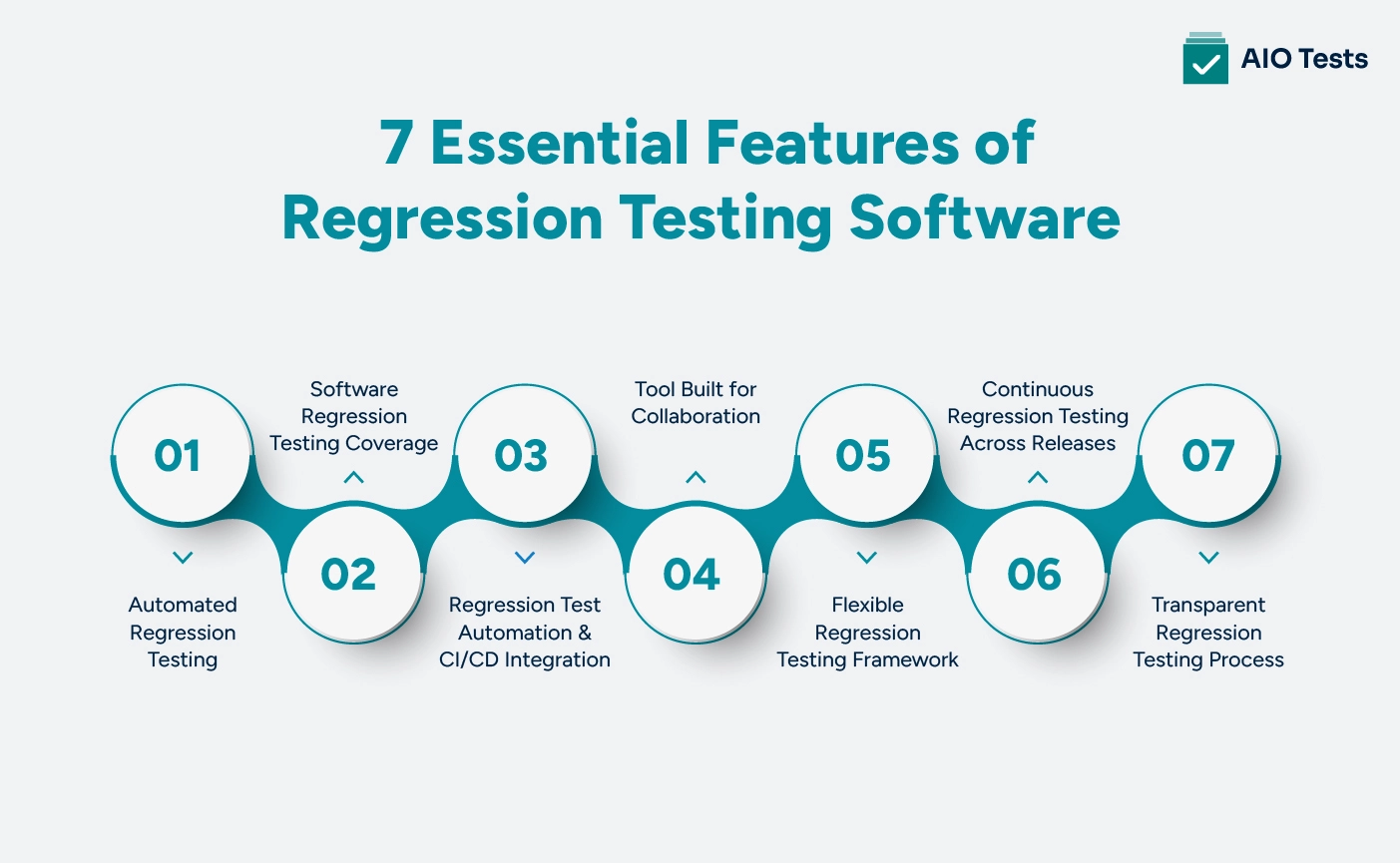
7 Essential Features Of Regression Testing Software
The following seven features provide a practical framework for evaluating any regression testing platform.
1) Automated Regression Testing
One of the primary goals of modern QA is to eliminate repetitive manual effort wherever possible.
Automated regression testing allows teams to execute previously validated test cases automatically whenever code changes occur. Instead of manually rerunning hundreds or thousands of tests after every release, automation handles execution consistently and efficiently.
The benefits are significant:
- Reduced testing time
- Lower manual effort
- Faster release cycles
- Improved test consistency
- Better defect detection
Automation becomes especially valuable for large applications where repeating manual test cycles can consume entire QA sprints.
However, effective automation goes beyond execution. The best platforms also help simplify test creation, maintenance, and management. Teams should look for solutions that reduce the overhead associated with building and updating regression suites.
As release frequency increases, automation transitions from a productivity enhancement to a necessity.
2) Software Regression Testing Coverage
Automation alone isn't enough if testing coverage remains incomplete.
Strong software regression testing coverage ensures that teams validate all critical areas of an application whenever changes are introduced. This includes testing across:
- User interfaces
- Backend services
- APIs
- Databases
- Third-party integrations
- Business workflows
- Cross-functional dependencies
Many production issues occur because teams focus only on the area being modified while overlooking connected systems.
For example, a seemingly simple update to a customer onboarding workflow could unintentionally affect user authentication, billing integrations, reporting functions, or notification services.
A quality regression testing platform should help teams organize and track coverage across multiple application layers. It should make it easy to identify gaps, monitor tested requirements, and verify that high-risk functionality remains protected.
Comprehensive coverage reduces the likelihood of defects escaping into production while increasing confidence during every release cycle.
3) Regression Test Automation and CI/CD Integration
Modern software delivery depends on speed.
Testing that occurs only after development is complete creates bottlenecks that slow releases and increase risk. That's why regression test automation and CI/CD integration have become an essential platform capability.
The best regression testing solutions integrate directly into continuous integration and continuous delivery pipelines.
This enables teams to:
- Trigger regression tests automatically after code commits
- Validate builds before deployment
- Receive immediate feedback on failures
- Prevent defective code from progressing through environments
- Accelerate release approvals
When testing becomes part of the delivery pipeline, quality assurance shifts left and becomes a continuous activity rather than a final checkpoint.
Organizations that successfully integrate regression testing into CI/CD workflows often experience shorter release cycles, reduced rework, and faster defect resolution.
A platform that cannot support modern automation workflows may eventually become a bottleneck rather than an enabler.
4) A Regression Testing Tool Built for Collaboration
Regression testing is no longer the responsibility of QA teams alone.
Developers, product managers, business analysts, and release managers all contribute to software quality. That's why organizations increasingly need a regression testing tool built for collaboration.
Collaboration features help align stakeholders around shared quality goals.
Key capabilities include:
- Shared dashboards
- Centralized test repositories
- Role-based access controls
- Requirement traceability
- Defect visibility
- Cross-team reporting
The most effective platforms also support both technical and non-technical users.
Developers may focus on automation results and pipeline integrations, while product owners need visibility into business requirements and release readiness. A collaborative platform ensures both groups can access relevant information without unnecessary complexity.
Better collaboration leads to faster decisions, reduced communication gaps, and improved release confidence.
5) A Flexible Regression Testing Framework
Software environments constantly evolve.
Applications expand, teams grow, and testing requirements become more sophisticated. As a result, organizations need a flexible regression testing framework that can adapt over time.
Flexibility typically includes support for:
- Manual testing
- Automated testing
- Hybrid testing approaches
- Reusable test assets
- Modular test design
- Scalable execution models
Reusable test cases are particularly important.
Without reusable components, teams often duplicate effort whenever applications change. Maintaining large regression suites becomes increasingly difficult and costly.
A flexible framework allows organizations to create reusable test assets that can be combined, modified, and executed across different projects and releases.
This approach improves efficiency while making long-term regression management more sustainable.
6) Continuous Regression Testing Across Releases
Quality assurance cannot stop between releases.
As software delivery accelerates, organizations require continuous regression testing across releases to maintain stability while supporting rapid development.
Continuous testing involves executing regression suites regularly rather than only before major deployments.
Common approaches include:
- Scheduled regression runs
- Nightly executions
- Build-triggered testing
- On-demand validation
- Risk-based regression cycles
The goal is rapid feedback.
The sooner teams discover defects, the less expensive they become to fix. Early detection prevents issues from spreading across environments and impacting downstream development work.
Continuous regression testing creates a proactive quality culture. Instead of reacting to defects after deployment, teams identify and resolve issues before they reach users.
For organizations pursuing DevOps and Agile practices, continuous testing is a foundational capability.
7) A Transparent Regression Testing Process
Testing effectiveness depends heavily on visibility.
Without clear reporting, stakeholders struggle to understand release readiness, testing progress, and quality trends. This makes a transparent regression testing process essential.
Transparency requires more than pass/fail indicators.
Organizations need:
- Real-time execution status
- Requirement traceability
- Defect tracking
- Historical reporting
- Audit trails
- Build-level visibility
- Stakeholder dashboards
Transparent reporting allows leadership teams to make informed release decisions based on objective data rather than assumptions.
It also simplifies compliance requirements by maintaining documented evidence of testing activities and outcomes.
When everyone can clearly see what has been tested, what passed, what failed, and what remains unresolved, quality management becomes significantly more effective.
How AIO Tests Is the Best Pick For A Regression Testing Software Platform?
The seven criteria above provide a practical framework for evaluating any solution. When mapped against the platform's actual capabilities, AIO Tests align closely with each requirement.
- Native Jira Integration
AIO Tests is the all-in-one, test management tool for jira. It operates directly within Jira, connecting requirements, test cases, executions, and defects in a unified environment.
This eliminates context switching between separate tools while improving traceability and process transparency. Teams can follow the entire testing lifecycle, from requirements creation through defect resolution, without leaving Jira.
- AI-Assisted Test Case Generation
AIO Tests supports AI-powered test case generation from Jira requirements and user stories.
This capability helps teams accelerate test creation while reducing manual effort. It directly supports automation initiatives by simplifying one of the most time-consuming aspects of regression testing.
- Reusable Regression Sets
Regression and smoke tests can be organized into reusable test sets that can be incorporated directly into execution cycles.
This supports a scalable and flexible regression testing framework while reducing duplication and simplifying long-term maintenance.
- CI/CD and Automation Framework Support
AIO Tests provides REST API integrations, Jenkins pipeline support, and result reporting from popular automation frameworks, including:
- Cucumber
- TestNG
- JUnit
- Robot Framework
- Playwright
- Katalon
These capabilities support automated execution, CI/CD integration, and continuous regression testing across releases.
- Built-In Reporting
The platform includes reporting for:
- Test execution status
- Coverage tracking
- Automation metrics
- Defect management
Reports can be exported and scheduled for stakeholders, helping organizations maintain transparency and release visibility.
- Collaboration Across Manual and Automation Teams
BDD support helps standardize communication between QA and development teams.
This improves collaboration by creating a shared understanding of requirements, expected outcomes, and testing objectives across both manual and automated testing efforts.

How to Choose the Right Regression Testing Software
When evaluating solutions, use the following checklist:
✓ Supports automated regression testing
✓ Delivers comprehensive software regression testing coverage
✓ Integrates directly with CI/CD pipelines
✓ Enables collaboration across technical and non-technical teams
✓ Provides a flexible regression testing framework
✓ Supports continuous regression testing across releases
✓ Offers transparent reporting, traceability, and auditability
Rather than focusing primarily on brand recognition, evaluate how effectively each platform satisfies these requirements.
A solution that checks all seven boxes is more likely to support long-term quality objectives, scale with organizational growth, and improve release confidence. As demonstrated above, platforms like AIO Tests align closely with these evaluation criteria by addressing each capability directly.
What’s Next?
Choosing the right platform becomes significantly easier when feature requirements are clearly defined from the start.
Selecting a regression testing platform is ultimately about reducing risk while increasing release velocity. The most effective teams focus less on vendor popularity and more on the capabilities that directly impact testing outcomes.
The seven features outlined in this guide, automation, coverage, CI/CD integration, collaboration, framework flexibility, continuous execution, and transparency, form the foundation of an effective testing strategy.
Organizations that prioritize these capabilities are better positioned to deliver reliable software, accelerate releases, and maintain quality at scale.
When evaluating your next solution, use these criteria as a decision-making framework. The right platform won't simply help you run tests; it will help your entire organization build confidence in every release through effective regression testing.

FAQs
1) What features should regression testing software have for agile teams?
Agile teams need regression testing software that supports automation, CI/CD integration, continuous testing, and collaboration. These features help teams validate changes quickly and maintain release velocity without compromising quality.
2) Is regression testing software different from test management software?
Yes. Regression testing software focuses on validating existing functionality after code changes, while test management software helps organize test cases, executions, requirements, and reporting. Many modern platforms combine both capabilities in a single solution.
3) Can regression testing software handle both manual and automated tests?
Most modern regression testing platforms support both manual and automated testing workflows. This allows teams to manage all testing activities in one place while gradually increasing automation coverage over time.
4) How does regression testing software integrate with CI/CD pipelines?
Regression testing software can integrate with CI/CD tools like Jenkins and automatically trigger test execution after code commits or builds. This provides immediate feedback on software quality and helps prevent defects from reaching production.
5) What is the difference between a regression testing tool and a regression testing framework?
A regression testing tool is the platform used to create, manage, execute, and report on tests. A regression testing framework is the structure and methodology that support test organization, reusability, scalability, and execution across projects.


.svg)

