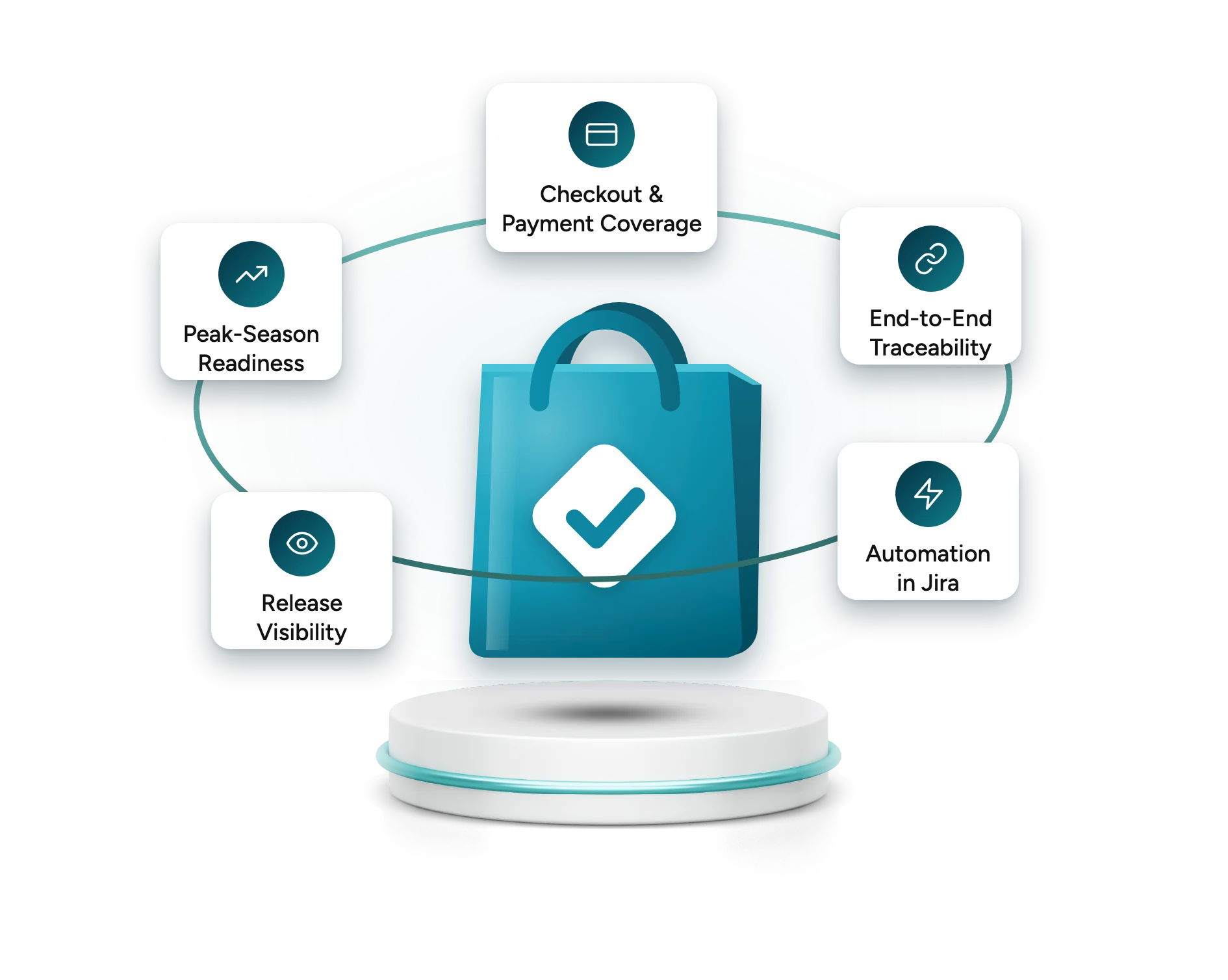









Weekly retail updates outpace regression suites, letting hidden coverage gaps leak into production before anyone catches them.
Payment or discount errors cost sales the moment they go live. Checkout spans gateways, promotions, tax, and fulfilment, so the combinations that break are rarely the ones anyone thought to test.
Storefront, backend, and mobile tools leave teams with no single view of what's tested, what passed, and what's open.
High-traffic events like Black Friday leave zero room for blind spots. Without real-time tracking, teams release on pure assumptions.
Automated test results sit trapped in CI/CD pipelines and dashboards, disconnected from the Jira issues they validate.
From companies like Marc O'Polo to thousands of Jira teams, organizations rely on AIO Tests for governed, traceable test management.

AIO Tests runs directly in Jira, with retail storefront and backend test data scoped to your Jira project, and no separate logins or external test tools to maintain.
Manage retail testing permissions using your existing Jira rules. Eliminate duplicate user management and close visibility gaps between developers and QA.
Log every edit across e-commerce regression suites with user and timestamp details, keeping your retail test library completely auditable across every release cycle.
AIO Tests hosts test data in US and EU regions, matched automatically to your Jira region, and is ISO 27001 certified.



January 9, 2024


“We've been using AIO since May 2023 and chose it from a number of applications previously used and considered. Several dozen people testing complex business processes across multiple systems from multiple companies. AIO has performed brilliantly and allows us to manage once to report results.”
✓ Verified Atlassian Marketplace review

July 19, 2024
“We've been using AIO for approximately 3 years now and the product works well at an affordable price at scale. The product team makes improvements every quarter and their support staff is extremely responsive. The built-in reporting is very handy for our weekly reports.”
✓ Verified Atlassian Marketplace review
AIO Tests gives QA teams a single place in Jira to manage testing for retail and e-commerce, from sprint planning to release sign-off, across every team, tool, and product area.
Retail teams ship updates constantly: new features, promotions, catalog changes, and integration updates, all of which need regression coverage. AIO Tests lets teams build reusable test sets for core flows like checkout, search, and payment integrations, and execute them consistently every sprint. Requirements link directly to test cases and defects, so QA leads always have a current view of what's covered, what's failing, and what's blocking the next release without pulling data from multiple tools.
Yes. Retail QA teams running automated software testing for retail across frameworks like Cypress, Playwright, JUnit, or Postman/Newman can report results directly into AIO Tests via REST APIs or CI/CD integrations. Those results sit alongside manual test execution records in the same Jira project, giving QA leads and product managers a unified view of coverage and defect status across web, mobile, and backend without switching between dashboards.
Peak season releases require more regression confidence than a standard sprint: more test cases, more environments, and more stakeholders asking if the platform is ready. AIO Tests gives retail QA teams structured execution cycles with target timelines, so teams know whether they're on track well before the launch date. Execution burndown charts and live Jira dashboard gadgets give product and engineering leads real-time visibility into testing progress without waiting for a manual status report.
Yes. Shared folder structures and configurable workflows let QA leads apply consistent test design standards across storefront, backend, mobile, and integration teams. Reusable test sets mean regression suites defined for one release cycle carry forward cleanly to the next. Permission controls manage access at the project level, so each squad works within its own scope while QA leads maintain visibility across the full release.
No. AIO Tests is a test management platform. It plans, executes, and tracks functional, regression, and acceptance testing, and integrates with the specialist tools teams use for security and performance testing.


