

.webp)
Summarize Blog
Quick Summary
Agile teams shipping daily or multiple times per week cannot keep pace with manual regression testing, as it becomes either a release bottleneck or a quality risk. AI regression testing solves this by automating test case creation, reducing execution time, and enabling teams to maintain quality while accelerating releases
Your sprint wraps on Friday. Three features shipped, six bugs crushed, everything works in staging. Then Monday morning hits. Payment processing is down. Support tickets pile up. Within an hour, you've lost 15% of transaction volume.
The root cause? A change to authentication broke an edge case in the payment gateway nobody tested. It's a regression, and it's costing you money and reputation.
This isn't a one-off disaster. It's happening to 60% of development teams right now. Manual regression testing can't keep pace with agile velocity. You're shipping faster than you can test.
But here's the shift: you don't have to choose between speed and safety anymore. AI-powered regression testing changes everything. Instead of humans manually writing and maintaining thousands of test cases, AI learns your application, generates tests automatically, adapts to UI changes, and knows exactly which tests matter for each release.
This guide walks through five real-world use cases where AI regression testing delivers ROI in weeks.
The Regression Testing Paradox in Agile: Speed vs. Safety
When you're deploying daily or multiple times a week, manual regression testing becomes a bottleneck. Your QA team either becomes a release gate (slowing you down) or regression gets deprioritized (shipping bugs).
Traditional automation tools worsen this problem. They require:
- Manual test script creation for every new feature
- Regular maintenance when UIs change (which happens constantly in agile)
- Predetermined test cases that can't adapt to unexpected code paths
- Fragmented execution across multiple tools and environments
AI regression testing inverts this model. Instead of humans writing tests, AI learns your application, generates tests automatically, updates them when UIs change, and prioritizes tests based on actual risk.
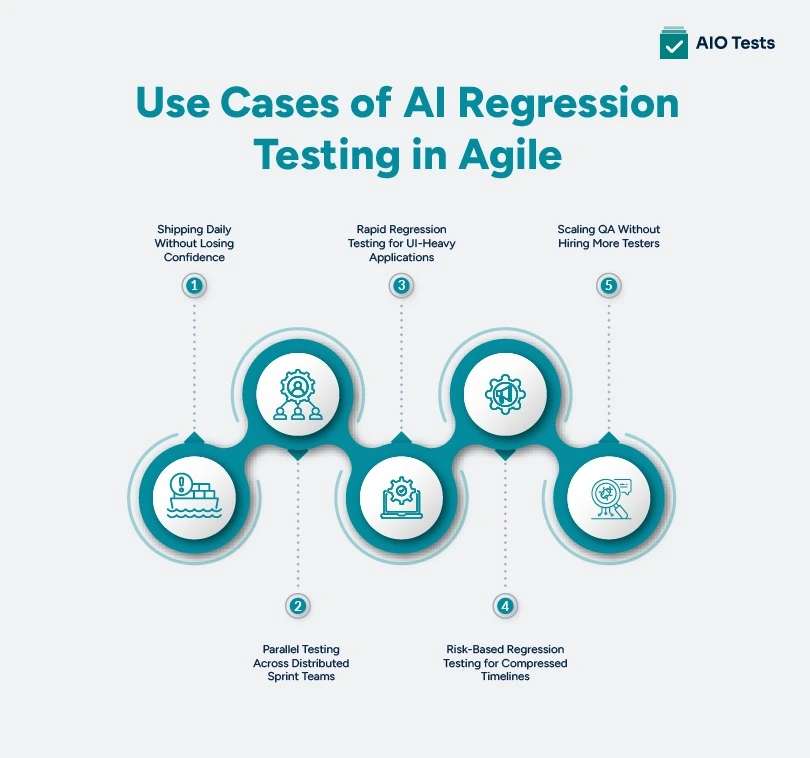
Use Case #1: Shipping Daily Without Losing Confidence
The Problem: Your team ships 5–10 times a day. Each deployment introduces new code. With manual regression testing, you'd need to re-run 500+ test cases after every commit impossible in a daily workflow.
The AI Solution: AI regression testing selects only the relevant test cases for each change. If you modified the checkout flow, the AI knows to prioritize tests for cart validation, payment processing, and order confirmation, but skip tests for user profile or login. Irrelevant tests don't slow you down.
AI generates new test cases automatically. When developers add a new payment gateway, AI creates regression tests for that module without waiting for manual test writing.
Real-World Impact:
- Test execution time: 60–70% faster (testing only what matters)
- Time-to-deployment: Cut from hours to minutes
- Defect escape rate: Down 40–50% due to smarter test prioritization
Why It Matters for Agile: Daily releases require ruthless efficiency. AI regression testing makes regression testing faster than skipping it, so teams never compromise on coverage.
Use Case #2: Parallel Testing Across Distributed Sprint Teams
The Problem: Your team is split: three developers working on the mobile app, two on the backend API, and one on the admin dashboard. Each finishes features on different days. Testing waits for everything to be integrated. Then regression testing starts, and it becomes a sequential bottleneck.
The AI Solution: AI regression testing runs continuously as code lands. When the mobile dev commits a feature, regression tests for that module start automatically, without waiting. Meanwhile, the API team's tests run in parallel. By the time everything integrates, you already know what breaks.
AI also detects cross-module impacts. A change to the authentication service might affect the mobile app, dashboard, and API. AI identifies these dependencies and automatically includes related regression tests, catching integration bugs before manual testing even starts.
Real-World Impact:
- Parallel test execution: Test multiple modules simultaneously
- Reduced feedback loop: From hours to 15–20 minutes
- Fewer integration surprises: AI catches cross-module regressions automatically
Why It Matters for Agile: Agile values continuous integration. AI regression testing makes CI actually continuous by removing the manual testing bottleneck.
Use Case #3: Rapid Regression Testing for UI-Heavy Applications
The Problem: You're building a SaaS dashboard, e-commerce platform, or collaborative tool. UIs change weekly, buttons move, layouts shift, and colors update. Traditional regression testing breaks because:
- Locators change with every UI update
- Manual test maintenance becomes a full-time job
- Test scripts become brittle and fail on minor UI tweaks
The AI Solution: AI-powered regression testing uses visual intelligence and semantic understanding instead of brittle locators. It recognizes elements by their role (e.g., "the primary action button") rather than their CSS selector. When the button moves, colors change, or layout shifts, the test still works.
When tests do fail, AI analyzes the failure and determines if it's a real regression (logic broken) or a UI change (just cosmetics). False positives disappear.
Real-World Impact:
- Test maintenance overhead: 70–80% reduction
- UI change velocity: Increase by 2–3x without test failures
- False positive rate: Near-zero
Why It Matters for Agile: Modern agile teams iterate on design constantly. AI regression testing frees teams from the test maintenance trap, letting designers and frontend devs move fast.
Use Case #4: Risk-Based Regression Testing for Compressed Timelines
The Problem: It's the day before a major release. You've merged 47 commits from your feature branches. You should run a full regression, but there's no time. Do you deploy and hope? Or delay the release?
The AI Solution: AI regression testing analyzes code changes and prioritizes tests by business risk. If you modified the checkout flow, AI ranks those tests as critical. If you updated a CSS comment, it ranks it as low risk. You run the highest-impact tests first and stop only when you hit your time constraint or coverage target.
This isn't guesswork. AI learns from your codebase, git history, and past defects to calculate actual risk, not perceived risk.
Real-World Impact:
- Compression without compromise: Test 80% of critical paths in 30% of the time
- Release confidence: Deploy with known risk instead of unknown risk
- Post-release incidents: Reduced by 35–45%
Why It Matters for Agile: Agile works on tight cycles. Risk-based regression testing makes it safe to ship on deadline without full regression, a practical necessity for real-world agile teams.
Use Case #5: Scaling QA Without Hiring More Testers
The Problem: You're growing: more features, more code, larger test suite. Your regression test suite has grown to 2,000+ cases. Running it manually is impossible. Running it with brittle QA automation tools requires constant maintenance. Hiring more QA engineers doesn't scale; they spend 50% of their time on test maintenance, not creating new tests.
The AI Solution: AI regression testing eliminates manual test maintenance. AI automatically updates test cases when code changes, adapts tests when UIs shift, and removes flaky tests. This frees your QA team to focus on quality strategy, deciding what to test, not maintaining tests.
Additionally, AI generates tests automatically from requirements, code changes, and user behavior patterns. Your 2,000 test cases become 5,000 in months—without proportional headcount increases.
Real-World Impact:
- QA productivity: +40–50% (less maintenance, more strategy)
- Test coverage growth: 2–3x without hiring
- Cost per test: Reduced significantly
- Scaling ceiling: Removed (AI scales; humans don't)
Why It Matters for Agile: Agile is about sustainable delivery. AI regression testing lets teams maintain velocity as they grow without burning out QA.
What Makes AI Regression Testing Smarter Than Traditional Automation Tools?
AI-powered regression testing doesn't just automate test execution or create test execution reports. It adds an intelligence layer that continuously improves:
1. Autonomous Test Generation
AI analyzes code changes and automatically generates tests. No manual test writing for every new feature. Tests cover edge cases humans miss.
2. Dynamic Test Maintenance
AI detects when UIs change and automatically updates locators. No brittle selectors breaking every sprint. Self-healing reduces false positives.
3. Intelligent Prioritization
AI ranks tests by business impact, not alphabetically. Critical paths are tested first. Time-constrained testing becomes smart, not random.
4. Flaky Test Detection and Resolution
AI identifies tests that fail intermittently. Automatically analyzes root causes (timing issues, environment sensitivity, etc.). Removes noise from your results.
5. Cross-Module Impact Analysis
AI understands code dependencies. When you change authentication, AI knows it affects mobile, web, and API. Regression tests for related modules run automatically.
6. Continuous Learning
The more you use AI-powered regression testing, the smarter it gets. It learns your application's patterns, dependencies, and risk zones.
Conclusion
AI regression testing tools handle the execution - but execution is only half the story. The other half is knowing what ran, what failed, what's covered, and what to do next.
That's where AIO Tests fits in. It's a Jira-native test management tool that centralizes your test cases, cycles, and execution results - regardless of which automation framework or AI testing tool your team uses. Whether you're running Selenium, Cypress, Playwright, or any CI-integrated tool, AIO Tests gives you a single place to plan coverage, track results, and surface gaps.For agile teams shipping fast, that visibility is what turns test execution data into release confidence.
Book a free demo with AIO Tests or try it free for 14 days. No credit card required. Just results.
FAQs
1. What is AI regression testing, and how does it work?
AI regression testing uses machine learning to automatically generate, maintain, and prioritize test cases based on code changes. The AI continuously learns from test failures, eliminating flaky tests and improving accuracy over time. This makes regression testing with AI dramatically faster and more reliable than traditional automation.
2. What are the main use cases of AI regression testing in agile development?
The primary use cases include:
- Daily releases – Test only relevant changes, reducing execution time by 60-70%
- Parallel testing – Multiple teams test simultaneously without bottlenecks
- UI-heavy applications – Visual intelligence adapts to layout changes automatically
- Risk-based testing – AI prioritizes critical paths when time is constrained
- Scaling QA – Generate thousands of test cases without hiring more testers
AI regression testing for agile teams solves the fundamental tension between deployment speed and quality assurance.
3. How is AI-based software testing different from traditional test automation?
Traditional test automation requires manual test script creation and constant maintenance when code changes. AI-based software testing eliminates these manual tasks:
- Test generation: AI writes tests automatically instead of QA engineers
- Self-healing: Tests adapt to UI changes without human intervention
- Intelligent prioritization: Tests run by business impact, not alphabetically
- Flaky test detection: AI identifies and removes unreliable tests automatically
- Continuous learning: The system improves with every test execution
4. What makes a good AI regression testing tool?
Look for these essential features:
- Jira integration – Native integration with your agile workflow
- Framework compatibility – Works with Selenium, Cypress, TestNG, JUnit
- Auto-generation – AI generates test cases automatically
- Intelligent prioritization – Tests run by business impact
- Self-healing – Adapts to UI changes without manual fixes
- Real-time visibility – Team dashboards and collaboration features
- Trend analysis – Identifies flaky tests and recurring regressions
- Easy adoption – Delivers value in the first week, not months
The best AI regression testing tools integrate seamlessly into existing workflows and require minimal configuration.


.svg)
