


Summarize Blog
Quick Summary
A robust test data management strategy eliminates delivery bottlenecks by automating the provisioning of masked, compliant, and synthetic datasets. Integrating these workflows into native Jira frameworks ensures deterministic, high-velocity QA execution.
CI/CD pipelines deploy code in seconds, yet modern QA teams regularly watch automated regression suites stall for hours. The problem is rarely a broken feature; it is dirty, stale, or missing database states that cause false positives and flaky runs.
Test data management (TDM) solves this bottleneck by automating, securing, masking, and provisioning high-fidelity datasets directly into non-production environments. Modern TDM replaces fragile, shared production clones with lightweight, containerized micro-databases and AI-driven synthetic pipelines.
By decoupling parameters from test scripts, protecting sensitive PII, and aligning datasets with automated build triggers, software engineering teams eliminate flaky runs, ensure absolute regulatory compliance, and dramatically accelerate release velocity.
Why High-Velocity Teams Need a Modern Test Data Strategy
As software delivery pipelines accelerate, treating test data as an afterthought creates compounding technical debt. High-performing engineering organizations adopt a formal test data strategy to overcome three critical operational hurdles:
1. Eliminating Flaky Tests and Context Switching
Shared staging databases are notorious for causing test collisions. When parallel automation runs modify the same record simultaneously, such as a user account balance or order state, tests fail unpredictably. QA engineers lose hours triaging false positives, leading to test fatigue and release delays.
2. Strict Compliance and Data Security
Regulations like GDPR, CPRA, and HIPAA impose hefty fines for exposing customers’ Personally Identifiable Information (PII) in lower environments. A robust framework enforces test data security across staging environments, masking sensitive fields before data ever leaves production boundaries.
3. Streamlining Environment Provisioning
Relying on database administrators to manually restore multi-terabyte production backups can take days. Modern teams automate the creation of lightweight, isolated test environment data, giving developers fresh, reliable datasets on demand.
4. Expanding Test Coverage for Complex Edge Cases
Production data rarely reflects every scenario required for thorough QA, such as new user onboarding flows, negative account states, or boundary conditions. A structured TDM approach allows teams to generate targeted edge-case datasets on demand, expanding test coverage and ensuring rare bugs are caught before reaching end users.
5. Lowering Cloud Infrastructure Costs
Spinning up full database replicas across dozens of staging and QA environments inflates cloud storage bills significantly. Through data subsetting and containerization, teams extract only the 5%–10% subset of data required for validation, drastically reducing cloud resource consumption.
Core Pillars of Modern Test Data Management Solutions
Evaluating modern test data management solutions requires understanding the foundational capabilities that turn raw databases into high-utility, compliant QA assets.
Rather than treating data prep as a series of isolated one-off scripts, enterprise TDM platforms build on four core operational pillars:
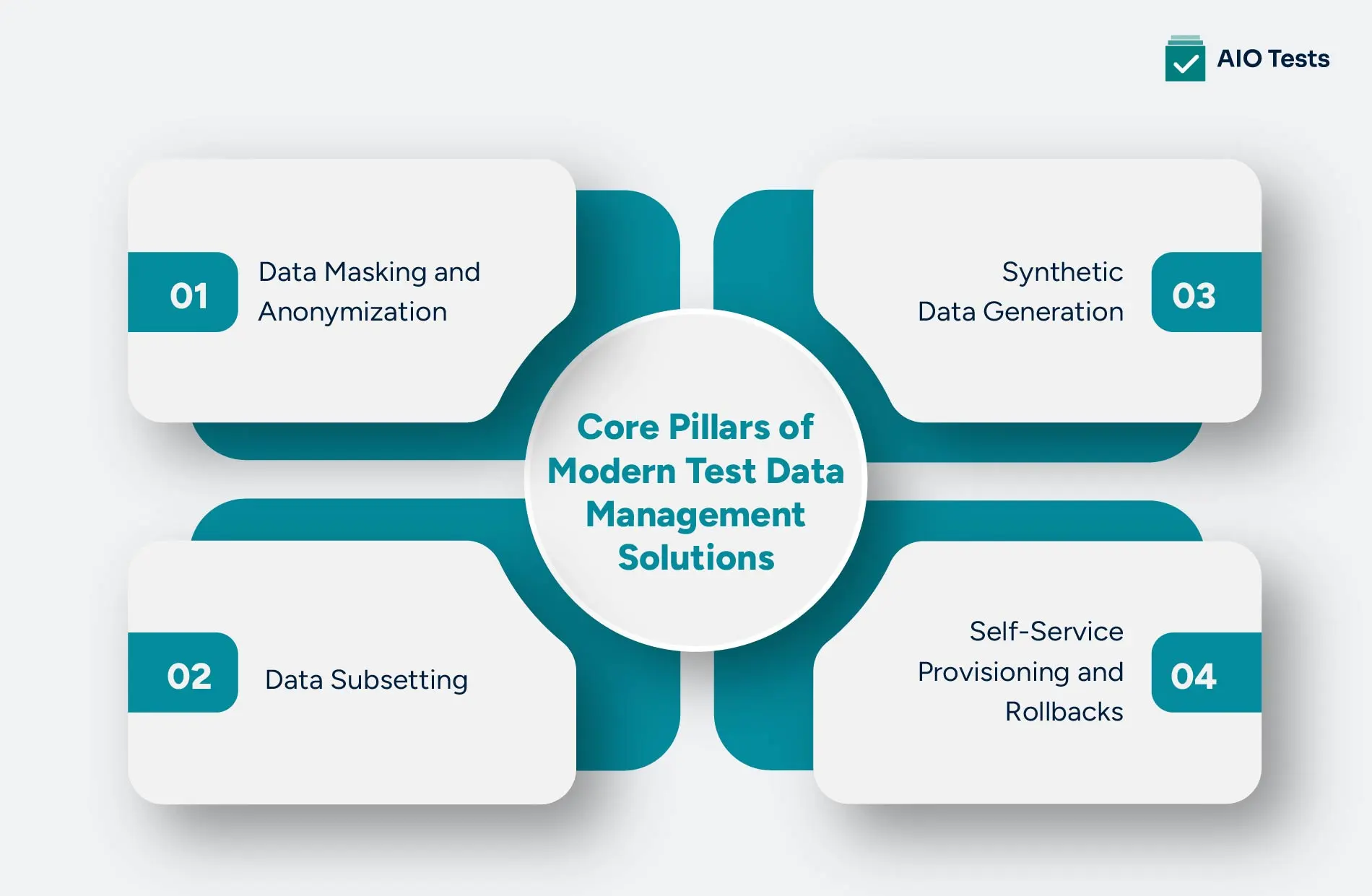
1. Data Masking and Anonymization
Data masking protects production records before they reach staging or local developer machines. It replaces sensitive values such as credit card numbers, social security records, and names with realistic, non-identifiable surrogates while maintaining string lengths, character formats, and data types.
- Static Data Masking (SDM): This transforms a production database clone at rest before copying it into non-production environments.
- Dynamic Data Masking (DDM): This masks sensitive fields on the fly during query execution based on user permissions, leaving the underlying store unchanged.
- Referential Masking: This ensures that a customer's ID maps to the exact same masked token across multiple microservices and relational tables, preventing broken foreign keys.
2. Data Subsetting
Copying a 10-terabyte production database into every QA environment is costly and time-consuming. Subsetting extracts a targeted, mathematically consistent sample of production data while traversing complex schema trees. It cuts cloud storage overhead and speeds up spin-up times without creating orphaned records or breaking constraints.
3. Synthetic Data Generation
When testing unreleased features or stress-testing systems beyond production scales, real databases fall short. Test data generation creates artificial datasets from scratch using schema configurations, business logic rules, or generative AI models.
4. Self-Service Provisioning and Rollbacks
Engineering velocity hinges on removing human dependencies. Modern TDM equips QA automation scripts and developers with self-service APIs to spin up ephemeral, pre-seeded database instances in seconds. Once tests complete, automated teardown hooks reset or destroy the instance to prevent state contamination.
Test Data Management Best Practices for High-Performing QA Teams
Implementing a modern test data management strategy requires moving away from reactive data preparation toward structured, automated workflows.
Leading engineering organizations adopt these eight test data management best practices to keep pipelines fast, compliant, and reliable:
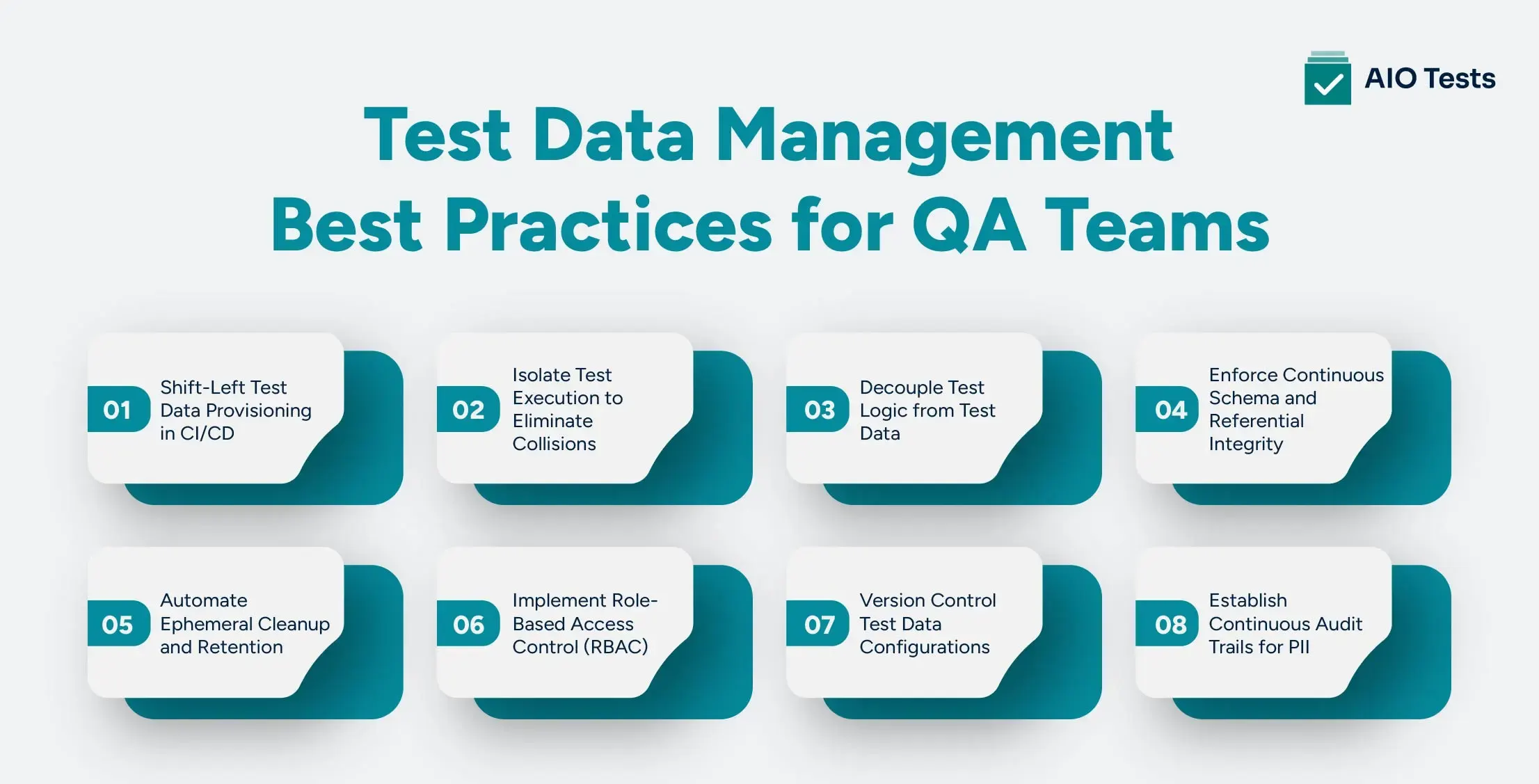
1. Shift-Left Test Data Provisioning in CI/CD
Waiting until late testing stages to prepare data causes severe deployment bottlenecks. High-performing teams embed automated test data provisioning directly into pull requests and build triggers. Spinning up containerized, pre-seeded micro-databases for isolated test branches catches integration errors early in the development lifecycle.
2. Isolate Test Execution to Eliminate Collisions
Shared test databases lead to intermittent test failures when parallel runs modify identical records concurrently. Teams maintain determinism by allocating isolated datasets per test run, resetting database state between executions, or implementing strict entity reservation mechanisms.
3. Decouple Test Logic from Test Data
Hardcoding data directly inside automated scripts creates brittle, high-maintenance test suites. Separating scenario steps from externalized dataset files allows QA teams to run parameterized workflows across diverse scenarios without duplicating codebase logic. This approach makes managing test automation data clean and scalable.
4. Enforce Continuous Schema and Referential Integrity
Subsetting and masking processes must respect complex entity relationship models across microservices. Automated schema checks ensure foreign keys, primary keys, and cross-database references remain consistent during dataset generation, preventing broken dependencies during test runs.
5. Automate Ephemeral Cleanup and Retention
Temporary staging databases accumulate rapidly, driving up cloud infrastructure costs and creating security vulnerabilities. Setting up automated teardown scripts to sweep, archive, or destroy ephemeral environments post-execution keeps cloud costs low and protects sensitive environments.
6. Implement Role-Based Access Control (RBAC)
Not all QA engineers or offshore contractors require access to full staging datasets. Implementing granular access controls ensures team members only interact with the specific masked subsets needed for their current work, strengthening compliance without impeding daily productivity.
7. Version Control Test Data Configurations
Treat test data generation rules, masking algorithms, and seed files with the same rigor as application source code. Store configuration scripts in Git repositories alongside test automation suites to ensure complete traceability, auditability, and effortless rollback of dataset states.
8. Establish Continuous Audit Trails for PII
To meet strict GDPR, SOC 2, and HIPAA audit requirements, maintain automated logging for all data extraction, masking, and provisioning events. Tracking who generated each dataset, where it was deployed, and when it was destroyed provides verifiable compliance evidence for regulatory reviews.
Building an End-to-End Test Data Management Strategy
Transitioning from ad hoc data creation to an enterprise-grade test data management strategy requires a structured, step-by-step implementation blueprint. Rather than attempting a massive overhaul overnight, engineering leaders build a sustainable data testing strategy across three distinct phases:
Step 1: Audit, Discovery, and PII Mapping
Before masking or provisioning data, teams must understand their application's data landscape.
- Map Data Assets: Identify all production, staging, and non-production data stores, including relational databases, NoSQL clusters, object stores, and third-party API mocks.
- Locate Sensitive PII: Run automated discovery scripts to scan database fields for regulated attributes (e.g., credit card numbers, email addresses, phone numbers, and SSNs).
- Document Schema Relationships: Map primary and foreign key constraints across microservices to maintain referential integrity during subsetting.
Step 2: Automate Creation, Masking, and Pipelines
Replace brittle, manual spreadsheet management with automated, code-driven workflows.
- Implement Reusable Masking Rules: Build centralized algorithms that consistently transform PII values across all relational tables and microservices.
- Build AI & Programmatic Generators: Integrate test data automation tools to create synthetic edge-case records for unreleased features or rare transaction states.
- Wire Provisioning to CI/CD Triggers: Connect test dataset snapshots directly to pull-request build triggers so developers receive fresh, pre-seeded containerized databases on demand.
Step 3: Define Governance, Access, and Cleanup
Long-term TDM success relies on maintaining strict operational guardrails and resource controls.
- Enforce Role-Based Access (RBAC): Restrict dataset access so team members only interact with the specific masked subsets required for their active sprint tasks.
- Establish Automated Retention Policies: Configure automated cleanup jobs to sweep, archive, or destroy temporary staging databases immediately post-testing.
- Maintain Audit-Ready Logs: Continuously log data extraction, masking, and provisioning events to satisfy regulatory audits for GDPR, SOC 2, and HIPAA compliance across all test data repositories.
Streamlining Data-Driven QA Directly in Jira
While database masking and subsetting handle backend infrastructure, modern QA teams still struggle to connect parameterized test data, scenario outlines, and execution results directly within their Jira workflows.
To bridge this gap, modern QA teams can use a Jira-native test management platform like AIO Tests to manage data-driven testing and execute test scenarios within Jira.
This Jira test management tool supports BDD testing and data parameters, allowing teams to run test scenarios across multiple datasets without duplicating test cases. It also provides GenAI-assisted test case generation for creating classic and BDD-style test cases.
AIO Tests also integrates with CI/CD and automation workflows through Jenkins, JUnit, Cypress, Newman, and REST API integrations. Automated execution results can be reported back to Jira, connecting test cases, execution cycles, requirements, and defects for end-to-end traceability.
Conclusion
Adopting modern test data management principles transforms QA from a release bottleneck into a fast, compliant, and highly predictable competitive advantage.
By pairing enterprise database masking and subsetting strategies with centralized, data-driven test execution directly inside Jira, engineering organizations achieve complete traceability, eliminate flaky runs, and accelerate deployment velocity. Managing test datasets effectively prevents expensive infrastructure sprawl while significantly reducing the time engineering teams spend debugging.
As software architectures become more complex, teams that prioritize automated data provisioning will consistently outpace those stuck in manual workflows. Investing in a structured data strategy helps ensure that automated test suites deliver reliable quality signals rather than false alarms. Modernizing your approach also helps quality assurance scale alongside your growing codebase.

FAQs
1. What are the best practices for test data management?
The best practices include automating data provisioning, isolating test data, separating test data from test logic, maintaining referential integrity, and masking sensitive information. Teams should also use RBAC, version control, automated cleanup, and audit trails to keep test data secure and reliable.
2. How do you manage test data for automated testing?
Use reusable, parameterized datasets that are separate from your test scripts and provision them automatically through CI/CD pipelines. Isolated or resettable test environments help prevent data collisions and keep automated test results consistent.
3. How do you create test data without using production data?
You can create test data using synthetic data generators, predefined business rules, schema-based generators, or AI-driven tools. These approaches create realistic datasets without exposing sensitive production information.
4. What is synthetic test data, and when should you use it?
Synthetic test data is artificially created data that mimics the structure and characteristics of real-world data without using actual customer records. It is useful for testing edge cases, unreleased features, security scenarios, and large-scale workloads where production data is insufficient or inappropriate.
5. Why is test data management important in software testing?
Test data management helps QA teams maintain reliable, secure, and repeatable testing environments. It reduces flaky tests, protects sensitive data, speeds up test execution, and improves test coverage across different scenarios.


.svg)

