

.webp)
Summarize Blog
Quick Summary
In 2026, AI Test Management will help QA teams handle testing more efficiently. By automating repetitive tasks and improving test coverage, teams can execute test cases faster and with fewer errors. See how AI Test Management can simplify QA processes and improve software quality.
Software isn’t waiting, so why should QA?
Teams face constant pressure to deliver faster, reliable releases, but traditional test management slows them down. Manual processes, scattered documentation, and limited visibility create bottlenecks and lead to costly mistakes.
AI test management changes the game. By handling repetitive tasks, highlighting potential issues, and improving test coverage, these tools help teams catch problems before they become serious.
With the rise of AI in software testing, QA teams can explore smarter ways to handle testing and reduce last-minute surprises. This blog looks at how AI test management and testing tools are changing the way teams work and deliver software with confidence.
Why AI Test Management Is Essential for Modern QA Teams
AI test management is the practice of using artificial intelligence to plan, organize, and monitor software testing activities. It helps QA teams prioritize test cases, predict risk areas, track defects, and optimize test coverage. Here’s why:
AI Capabilities in Test Management
1. Automated Test Case Creation
AI can generate test cases automatically by analyzing historical data, code changes, and previous test results. This means you don’t have to spend hours writing test cases manually. The tool does the heavy lifting, giving your team more time to focus on other tasks.
2. Faster Test Execution and Parallel Testing
With AI, tests can run faster and more efficiently, even across multiple environments. AI manages parallel testing, allowing your team to run tests simultaneously on different devices or configurations, cutting down testing time significantly and ensuring broad coverage.
3. Smarter Bug Detection
AI testing tools find bugs, and they predict where they might be. By analyzing patterns from previous test cycles, AI can identify potential issues earlier, reducing the chances of defects slipping through to production.
4. Real-time Reporting and Analytics
Real-time dashboards give immediate insights into test progress, quality metrics, and test results. AI-driven analytics can highlight trends and pinpoint weak spots in your code, helping your team make data-driven decisions without waiting for reports.
AI test management tools have become essential for teams aiming to enhance efficiency and ensure testing accuracy.
What Are The Key Features to Look for in AI Test Management Tools
When evaluating test management tools with AI features, here’s what you should prioritize:
- CI/CD Integration: Your tool should seamlessly integrate with your Continuous Integration/Continuous Deployment (CI/CD) pipeline. This ensures smooth automation of testing in each stage of the development cycle.
- Support for Both Manual and Automated Testing: Even with AI, there will always be a need for some manual testing. A good AI testing tool should support both automated and manual testing to give your team flexibility.
- AI-Driven Test Optimization: AI tools should help optimize test suites by identifying redundant or unnecessary tests. This reduces test execution time and ensures the most relevant tests are run.
- Scalability and Ease of Use: Your test management tool should scale with your team and adapt to increasing complexity. It should also be user-friendly, so your team isn’t bogged down by a steep learning curve.
- Seamless Collaboration Features: Look for tools that promote collaboration between developers, testers, and other stakeholders. Features like shared dashboards, comments on test cases, and team notifications can streamline communication and keep everyone aligned.
In short, AI software testing tools bring automation, smarter bug detection, and faster execution to your team. By incorporating these capabilities, QA teams can improve test accuracy, speed up delivery times, and ensure better coverage without the manual effort.

What Are the Top AI Test Management Tools for 2026?
Below, we’ll take a closer look at the best test management tools like AIO Tests, Katalon Studio, and Testim.
1. AIO Tests

AIO Tests is an AI test management tool that integrates seamlessly with Jira, available in the Atlassian marketplace. It helps QA teams efficiently create, manage, and execute test cases, simplifying the entire testing workflow. With the power of Generative AI, AIO Tests enables teams to automate repetitive tasks, identify potential issues early, and ensure high-quality software.
AI Capabilities:
- AI-Assisted Test Case Creation: The tool uses AI to auto-generate test cases directly from Jira requirements, and its AI-powered test case editing ensures those cases stay sharp, accurate, and aligned with rapid sprint changes.
- Multiple Case Styles: Generate traditional test cases or switch to BDD testing formats without friction, ensuring teams can align their documentation style with their delivery model.
- Customizable Templates: Specify the type of test case (e.g., positive, negative, or end-to-end) with just a few clicks.
- Multi-Language Support: Generate test cases in multiple languages, improving accessibility for global teams.
- Grammar and Translation Enhancements: AI features allow you to improve the grammar of your test cases or translate them instantly.
- Case Improvement Suggestions: AIO Tests offers AI-driven suggestions for enhancing test steps, further refining your test scenarios.
Pros:
- Seamless integration with Jira
- Powerful AI-driven features for test creation and optimization
- Multi-language support
- Easy-to-use interface
- Free for teams of up to 10 users. For teams of 11 or more, pricing starts at $21.78 per user, which is more affordable than many competitors.
Cons:
- Some advanced features may require training to utilize fully.
If you want to know more features or review pricing, you can explore AIO Tests on the Atlassian Marketplace.

2. Katalon Studio

Katalon Studio is a robust test automation platform designed to help QA teams automate testing and manage test cases efficiently. With AI-driven capabilities, Katalon enables users to create tests faster and run them across multiple environments. It can identify issues early in the development cycle.
AI Capabilities:
- Faster Test Creation: Katalon Studio uses AI to streamline test creation and reduce manual effort, helping you create tests quickly and efficiently.
- AI-powered Execution: Test execution is optimized by AI, ensuring that tests are run with speed and accuracy, regardless of the environment.
- Automated Debugging and Maintenance: Katalon’s AI automates the debugging process, reducing the time spent fixing issues.
- Cross-Platform Support: Run tests across web, mobile, API, and desktop apps with ease, thanks to AI-driven test management.
Pros:
- All-in-one automation solution supporting Web, API, Mobile, and Desktop testing.
- Minimal setup and easy integration with CI/CD pipelines.
- Codeless options make it beginner-friendly, while still supporting advanced users.
- Built-in smart waits reduce flaky tests and improve reliability.
Cons:
- The free version has feature limitations, making enterprise adoption less straightforward.
- The self-healing feature can be inconsistent in handling elements.
- Performance may slow down with very large test suites.
3. Testim
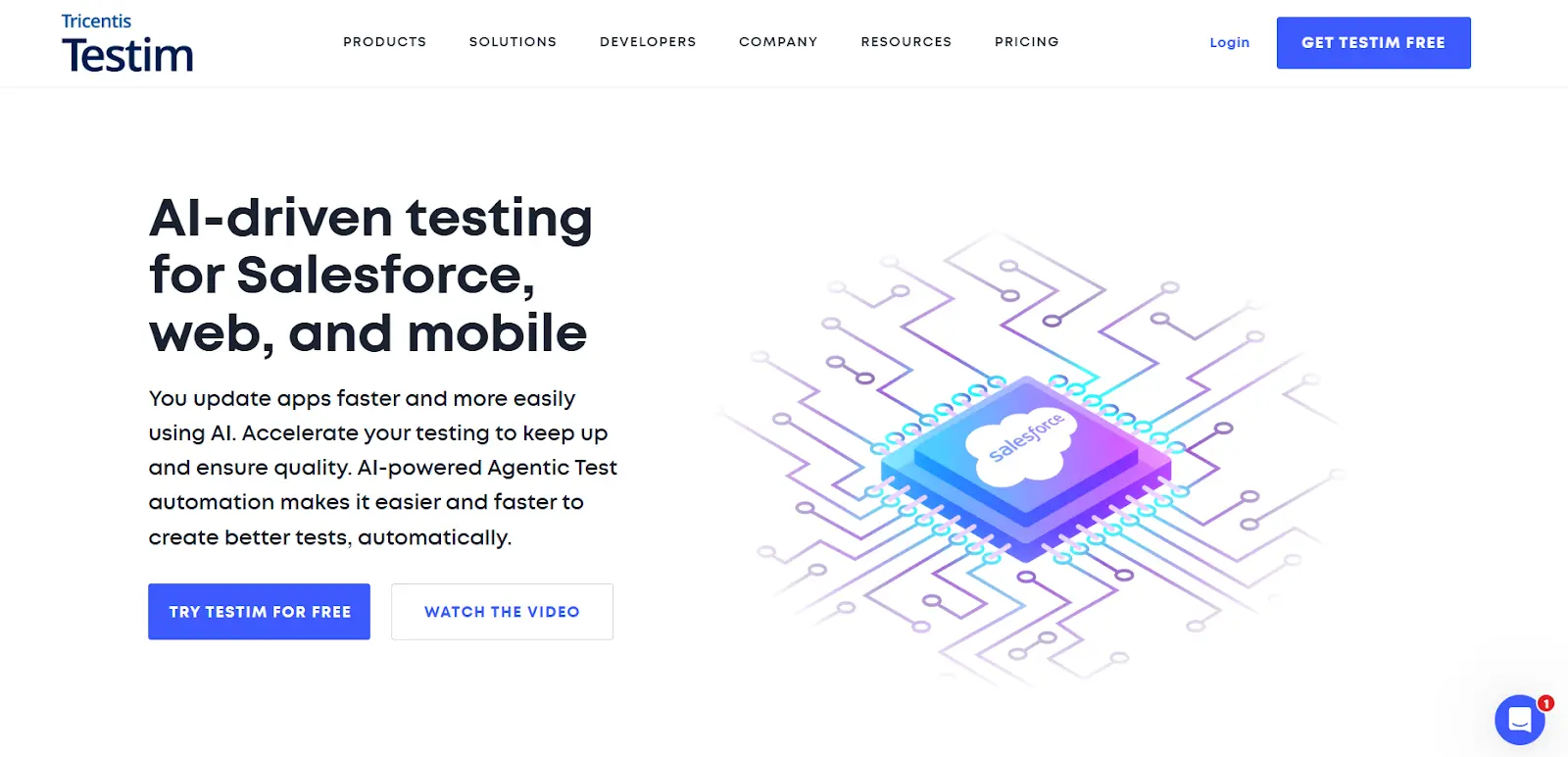
Testim is an AI-powered QA testing tool that simplifies test creation and maintenance for web, mobile, and app testing. With its AI-driven capabilities, Testim helps teams automate tests faster and with greater accuracy.
AI Capabilities:
- Natural Language Test Creation: Testim uses AI to convert natural language descriptions into automated test cases, reducing the complexity of test creation.
- AI-Driven Test Maintenance: Custom locators and machine learning enable Testim to identify and learn about new elements in your app, keeping tests stable and up to date.
- Automated Bug Detection: With Testim’s AI, potential issues can be detected early, allowing teams to fix critical bugs before they escalate.
- Seamless Integration with CI/CD: Testim works within your CI/CD pipeline, ensuring tests are run at the right time during development and deployment.
Pros:
- Intuitive and easy-to-use interface suitable for users without technical expertise
- Efficient for recording multiple tests quickly.
- Reliable customer support with onboarding guidance for enterprise clients.
Cons:
- Pricing lacks transparency compared to competitors.
- It can be challenging to automate highly complex or specialized testing scenarios.

Conclusion
AI test management tools improve how QA teams handle software testing. They reduce repetitive work, improve test coverage, and provide real-time insights, helping teams work faster and catch defects earlier.
With smarter test case creation, quicker execution, and clear reporting, QA teams can focus on critical tasks while maintaining software quality in fast development cycles. To see how AIO Tests can support your testing workflow, book a demo today.

FAQs
- What is an AI test management tool?
An AI test management tool helps create, organize, and optimize test cases using AI. Unlike traditional tools, it reduces manual effort, improves test coverage, and identifies potential issues early.
- How does an AI testing tool improve bug detection?
An AI testing tool can detect patterns and anomalies across large datasets and complex application flows. It often predicts high‑risk areas, identifies edge cases, and detects subtle issues (like UI changes, layout inconsistencies, or rare input combinations) that manual testers or conventional automation might miss. This leads to more consistent and reliable bug detection.
- Can AI test management support both manual and automated testing?
Yes. Many AI test management tools support hybrid workflows combining manual test cases with automated ones. They help manage, organize, and track test cases (manual or automated), and can assist in automating repetitive parts (like test case generation or regression runs) while still allowing manual oversight for complex or exploratory testing.
- What are the best AI tools for testers?
Some of the popular AI test management tools include AIO Tests, Katalon Studio, Xray, and TestRail. These tools help automate test case creation, optimize test execution, and provide AI-driven suggestions, making it a strong choice for QA teams looking to improve efficiency and test coverage.


.svg)

