


Summarize Blog
Quick Summary
Stop letting post-build bugs hijack your releases. Executing a shift left test strategy embeds QA early into requirements grooming and CI/CD pipelines, driving early defect detection while slashing remediation costs.
Pushing QA to the final phase of development is software engineering's most expensive habit. Finding a defect during post-build testing forces complex debugging, delays releases, and costs up to 30x more to fix than catching it during requirements grooming.
A shift left test strategy systematically eliminates this bottleneck by integrating quality assurance into the earliest stages of the software development lifecycle (SDLC). Rather than acting as late-stage gatekeepers, QA engineers become proactive quality architects who validate user stories, write executable BDD specs, and enforce automated CI/CD quality gates from day one.
The result? Early defect detection, faster deployment velocity, and predictable, zero-panic releases across Agile and DevOps engineering teams. Let’s understand more about the shift left test.
What is a Shift Left Test Approach in Modern QA?
To answer what is shift left testing, it helps to examine how testing has traditionally operated versus how modern quality engineering functions.
Shift Left Testing Meaning
At its core, shift left testing means embedding validation activities into every phase of the software lifecycle before code freeze occurs. Instead of waiting for a fully compiled application, testing begins at the requirement and design stages.
The Strategic Mindset Shift
Shifting left requires changing the fundamental question QA asks:
- Traditional Mindset: "Does this feature work after it has been built?"
- Shift Left Mindset: "Are these requirements clear, testable, and correct before we start coding?"
Adopting a shift left approach in testing focuses on preventing defects during creation rather than finding bugs after execution.
The Evolving QA Role
In a shift left quality assurance model, QA engineers no longer sit downstream waiting for builds. Instead, they partner directly with developers and product managers during early sprint ceremonies. QA brings an edge-case perspective to user story refinement, writes executable acceptance tests alongside developers, and helps design testable software architectures.
4 Core Pillars: How QA Teams Detect Defects Earlier in the SDLC
To unlock the full shift left testing benefits including lower defect remediation costs and faster release cycles QA teams rely on four main operational pillars:
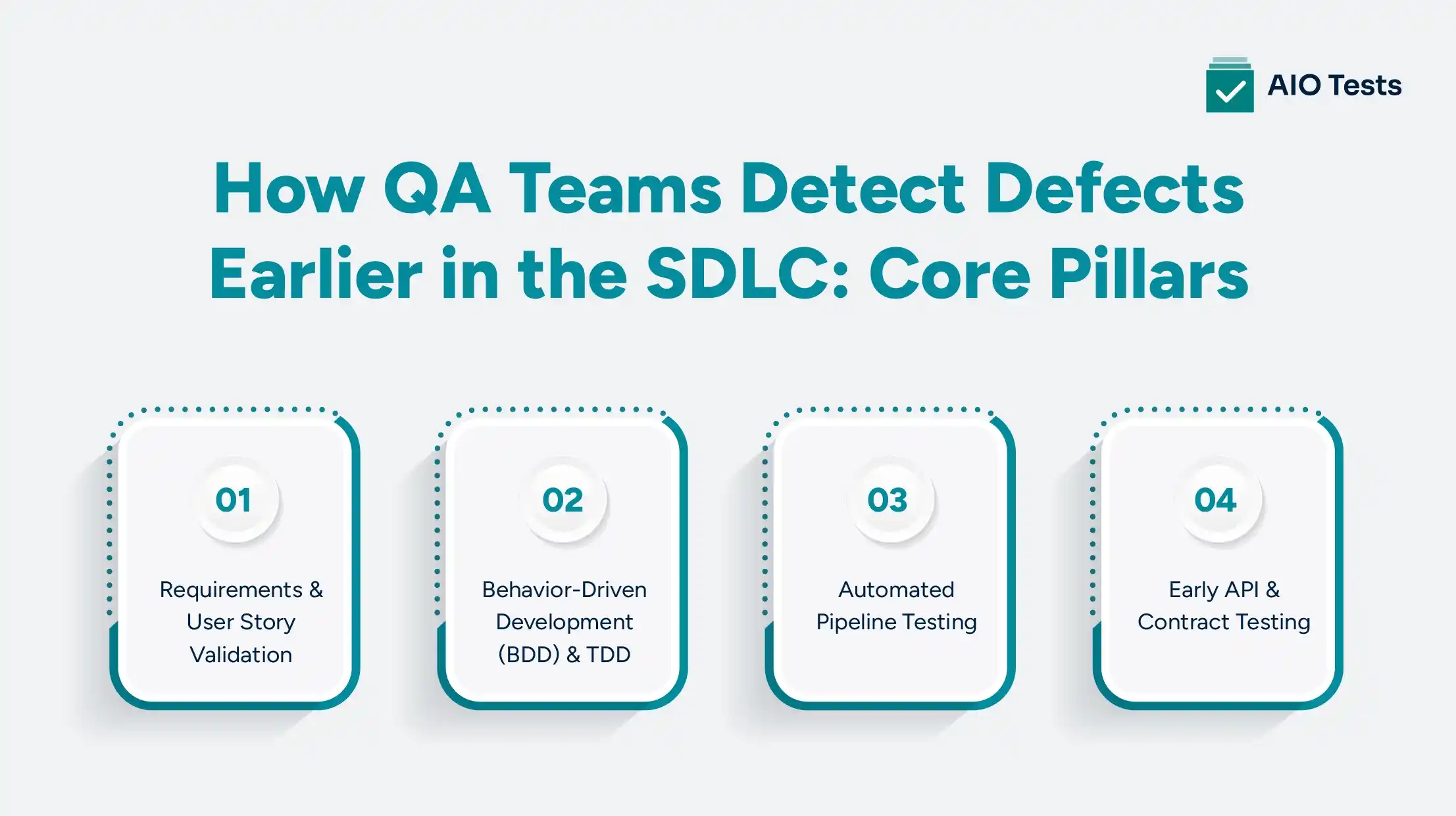
1. Requirements & User Story Validation
A significant portion of software defects originate from ambiguous, incomplete, or contradictory requirements. During sprint grooming, QA engineers review acceptance criteria to identify missing edge cases, security considerations, and logic gaps before developers write a single line of code.
2. Behavior-Driven Development (BDD) & TDD
Using frameworks like Cucumber or SpecFlow, QA teams collaborate with developers and product owners to write executable scenarios in human-readable language (Gherkin format: Given-When-Then). Defining expected software behaviors before coding ensures developers build against unambiguous test specifications.
3. Automated Pipeline Testing
Manual verification alone cannot keep pace with continuous integration. QA teams build automated test suites spanning unit, component, and static code analysis that execute automatically inside CI/CD pipelines. Every developer pull request triggers instant quality feedback.
4. Early API & Contract Testing
Waiting for a fully integrated graphical user interface (UI) to start testing delays defect discovery. By focusing on backend API endpoints and microservice contract testing early using tools like Postman or Pact, QA teams validate business logic and data integrations independent of UI completion.
Step-by-Step QA Workflow for Executing a Shift Left Test Strategy
Transitioning to an early defect detection workflow follows a structured 5-step process across every sprint:
1. Requirement Traceability & Grooming
QA engineers review user stories in Jira alongside product owners to identify ambiguous logic and edge-case gaps. Using native Jira test management apps, QA maps test cases directly to user stories at this stage to establish full requirements traceability before sprint execution.
2. Early Test Case Design
QA teams draft acceptance tests, BDD specs, and edge-case scenarios in parallel with developer architectural reviews, defining explicit definition-of-done criteria.
3. In-Sprint Local Code Validation
QA assists developers in setting up local test standards, automated unit test suites, and static code analysis rules (such as SonarQube) to catch code smells during feature creation.
4. Pull Request & Build Automation
Automated shift left test suites execute against every pull request. Automated build gates verify that unit tests, linting, and API contract checks pass prior to merging into main branches.
5. Continuous Feedback & Retrospectives
QA analyzes test telemetry and defect patterns to refine upcoming story definitions, improve automated test coverage, and prevent defect recurrence in future sprints.
Shift Left Testing Model vs Traditional QA Model
Comparing the operational dynamics of traditional testing against a modern shift left approach demonstrates why early quality integration is necessary for high-velocity teams:
Top Shift Left Testing Tools for QA Teams
Executing an early testing strategy requires the right tooling stack integrated across your development ecosystem:
- Test & Quality Management: AIO Tests - a native jira test management tool that allows QA teams to manage test suites, execute BDD scenarios, maintain end-to-end requirements traceability, and report on quality metrics directly inside Jira user stories.
- Static Code Analysis: SonarQube - Automated tools that scan source code for security vulnerabilities, bugs, and maintainability issues during code commit.
- API & Contract Testing: Postman - Frameworks for validating backend endpoints and microservice contracts prior to UI assembly.
- CI/CD Integration & Automation: GitHub - Automation engines that enforce quality gates by running unit, integration, and smoke tests on every pull request.
Overcoming QA Challenges in a Shift Left Test Transition
Adopting early testing practices often introduces operational friction. Here is how QA leads overcome common implementation hurdles:
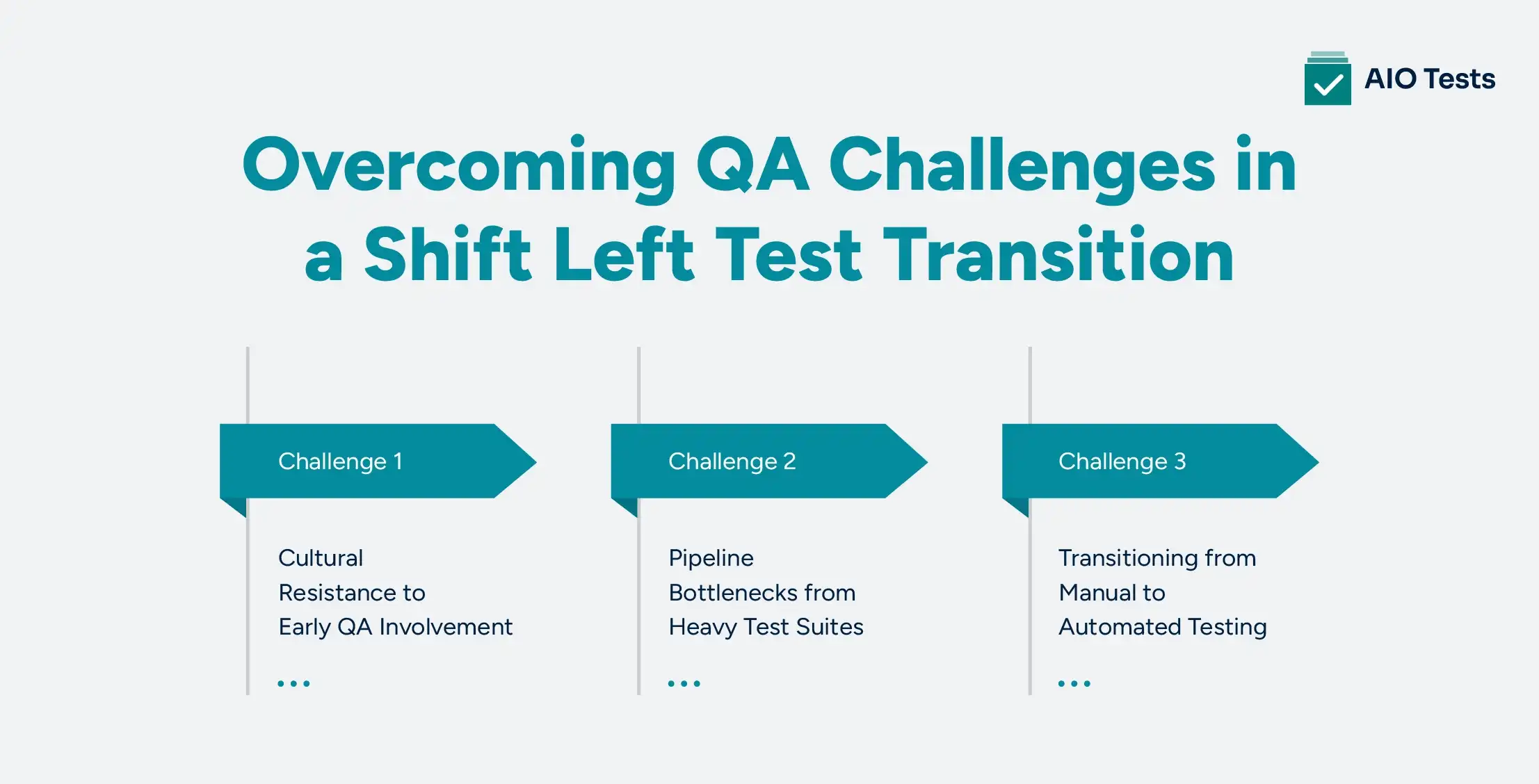
Challenge 1: Cultural Resistance to Early QA Involvement
- The Problem: Developers view early QA involvement as micromanagement or an obstacle to rapid coding.
- The Solution: Align engineering leads on shared quality KPIs (e.g., change failure rate, escape defect rate). Frame early QA reviews as a way to reduce developer rework and late-night hotfixes.
Challenge 2: Pipeline Bottlenecks from Heavy Test Suites
- The Problem: Running massive automated test suites on every pull request slows down development velocity.
- The Solution: Structure test automation hierarchically. Run fast unit tests, linters, and critical API checks on pull requests (< 5 minutes), while scheduling long-running end-to-end UI tests to run nightly.
Challenge 3: Transitioning from Manual to Automated Testing
- The Problem: Manual QA testers may lack the programming background required to write test automation code.
- The Solution: Pair QA engineers with software developers to co-author test automation scripts. Utilize BDD frameworks (Gherkin) and low-code test management tools to bridge the technical gap.
Shift Left Test Strategy vs Traditional Testing Comparison
To summarize the core differences between these two methodologies, evaluate how key operational parameters shift:
Conclusion
Adopting a robust shift left test strategy transforms modern quality assurance from a late-stage release bottleneck into an active, continuous engine for software excellence. By embedding QA professionals directly into requirements refinement, story grooming, code reviews, and CI/CD automation pipelines, engineering organizations build a proactive safety net that stops bugs before they reach production code.
Beyond lowering development costs and slashing defect remediation expenses, shifting testing to earlier phases builds a culture of shared quality ownership across developers, QA engineers, and product managers.
Equipped with native Jira test management solutions inside Jira alongside automated quality gates, QA teams can confidently accelerate release velocity, boost test coverage, and deliver high-reliability software to market faster.

FAQs
1. What does shift left testing mean in software testing?
Shift left testing is a software quality approach that moves testing activities to the earliest stages of the software development lifecycle (SDLC). Instead of waiting until after code is built, QA teams evaluate requirements, user stories, and system architecture alongside developers during planning. This proactive shift prevents bugs during creation rather than discovering them right before release.
2. What are the benefits of shift left testing?
Adopting a shift left test approach enables early defect detection, cutting bug remediation costs by up to 30x compared to post-build fixes. It accelerates release velocity, improves code quality, and eliminates late-stage deployment bottlenecks in Agile and DevOps pipelines. Additionally, it fosters a culture of continuous quality and shared accountability across developers, QA engineers, and product managers.
3. Why is shift left testing important?
Traditional late-stage testing creates expensive SDLC bottlenecks, leading to delayed releases, developer context-switching, and last-minute hotfixes. Shift left testing is critical because it addresses logic gaps and code defects when they are easiest and cheapest to fix. By validating software early and continuously, engineering teams deliver high-reliability features to market faster and with far less risk.
4. How does the shift left approach work in software testing?
The shift left approach integrates QA directly into early sprint ceremonies, requirements refinement, and architectural reviews. QA teams work with developers to define explicit acceptance criteria using frameworks like BDD (Behavior-Driven Development) and test endpoints early via API contract testing. As code is written, automated unit tests, static code analysis, and CI/CD quality gates continuously validate changes with every pull request.
5. How do shift left testing tools integrate with CI/CD pipelines?
Shift left testing tools connect to CI/CD platforms like GitHub Actions, Jenkins, or GitLab CI via webhooks and REST APIs. Native test management tools like AIO Tests in Jira automatically capture automated test results directly within user stories every time a build runs. These tools act as automated build gates, instantly failing pull requests if unit tests, static code checks, or API suites fail, ensuring only clean code merges into main branches.


.svg)

