

Summarize Blog
Quick Summary
Evaluate where test data is stored, processed, backed up, and accessed before choosing a platform. Review integrations, subprocessors, AI services, and contractual evidence to ensure the solution meets your enterprise data residency requirements.
QA teams have invested heavily in automation to improve testing speed and coverage, but maintaining those test assets remains an ongoing challenge. As applications change, new features are introduced, and requirements evolve, existing test cases can quickly become outdated, creating coverage gaps and increasing regression effort.
AI test maintenance helps teams manage this challenge by supporting test case improvement, identifying areas that require attention, and keeping testing workflows aligned with changing application behavior. Instead of spending significant time manually reviewing every update, QA teams can use intelligent capabilities to improve test quality, optimize coverage, and maintain reliable test repositories.
For Jira-based teams, combining AI assistance with a structured test management workflow provides better visibility across requirements, test cases, executions, defects, and automation results. This enables teams to maintain accurate test coverage while supporting faster and more confident software delivery.
What Are Data Residency Requirements in Enterprise Test Management?
Data residency requirements define where certain information must or should be stored and, in some situations, processed. They may originate from privacy laws, sector-specific regulations, customer contracts, government procurement conditions, internal policies or an organization’s own risk decisions.
The exact requirement depends on the data, jurisdiction and business context. For example, a customer contract may require all project information to remain in the EU. A financial institution may apply stricter controls to payment information. A healthcare organization may require additional safeguards for test data containing protected health information.
In enterprise test management, the scope can include much more than test cases. Screenshots, execution evidence, API responses, logs, defect comments and uploaded files may contain personal or production-like data.
Data residency compliance therefore begins with two questions:
- What information enters the testing workflow?
- Which legal, contractual and internal compliance requirements apply to it?
Enterprises should answer these questions before comparing platforms. A vendor cannot determine the complete requirement without understanding the organization’s data, customers, industry and operating regions.
How Do Data Residency, Data Localization and Data Sovereignty Differ?
These three terms are closely related, but they do not mean the same thing.
Not every privacy regulation creates a strict localization rule. For example, GDPR does not require all personal data to remain within the EU. It regulates transfers outside the European Economic Area and requires an approved transfer mechanism and appropriate safeguards. These can include adequacy decisions, Standard Contractual Clauses and Binding Corporate Rules.
Similarly, HIPAA does not impose a general US-only hosting requirement. However, covered organizations must assess the risks associated with where electronic protected health information is stored and processed.
The safest approach is to identify the exact rule or commitment that applies instead of treating privacy, security and residency as interchangeable terms.
Why Do Data Residency Requirements Matter for Test Data?
Testing information is often more sensitive than its label suggests.
A test case may describe internal business rules. A failed execution may include a screenshot containing a customer’s address. An API test may record authentication tokens or personal data in its request and response. Application logs can expose account identifiers, configuration details and system behavior.
Enterprise QA repositories can contain:
- Production-like data used for validation
- Customer details captured in screenshots
- Personal information included in test steps
- Authentication values in API payloads
- Financial or healthcare information in test evidence
- Application logs and error messages
- Source-code and environment details
- Defect records and developer comments
- User names, email addresses and activity records
This information can also travel beyond the main test management platform. Automation results may pass through Jenkins, GitHub Actions or another CI/CD system. Defects may be created in Jira. Reports may be exported to spreadsheets. Notifications may be delivered through email, Slack or Microsoft Teams. AI-assisted features may send requirements or prompts to an external model provider.
Secure test management depends on understanding this entire data flow. Checking only the location of the platform’s primary database can leave important copies, integrations and processing activities outside the residency review.
What Test Data Should Enterprises Include in a Residency Review?
Before comparing vendors, create an inventory of the information your testing workflow produces.
Classify each category according to its sensitivity, applicable jurisdiction and permitted location. This inventory gives QA, security and procurement teams a common basis for evaluating test management software for enterprises.

How Should You Evaluate Data Residency in a Test Management Platform?
A vendor comparison should cover the complete test-data lifecycle. The following seven areas help separate a meaningful residency commitment from a broad hosting claim.
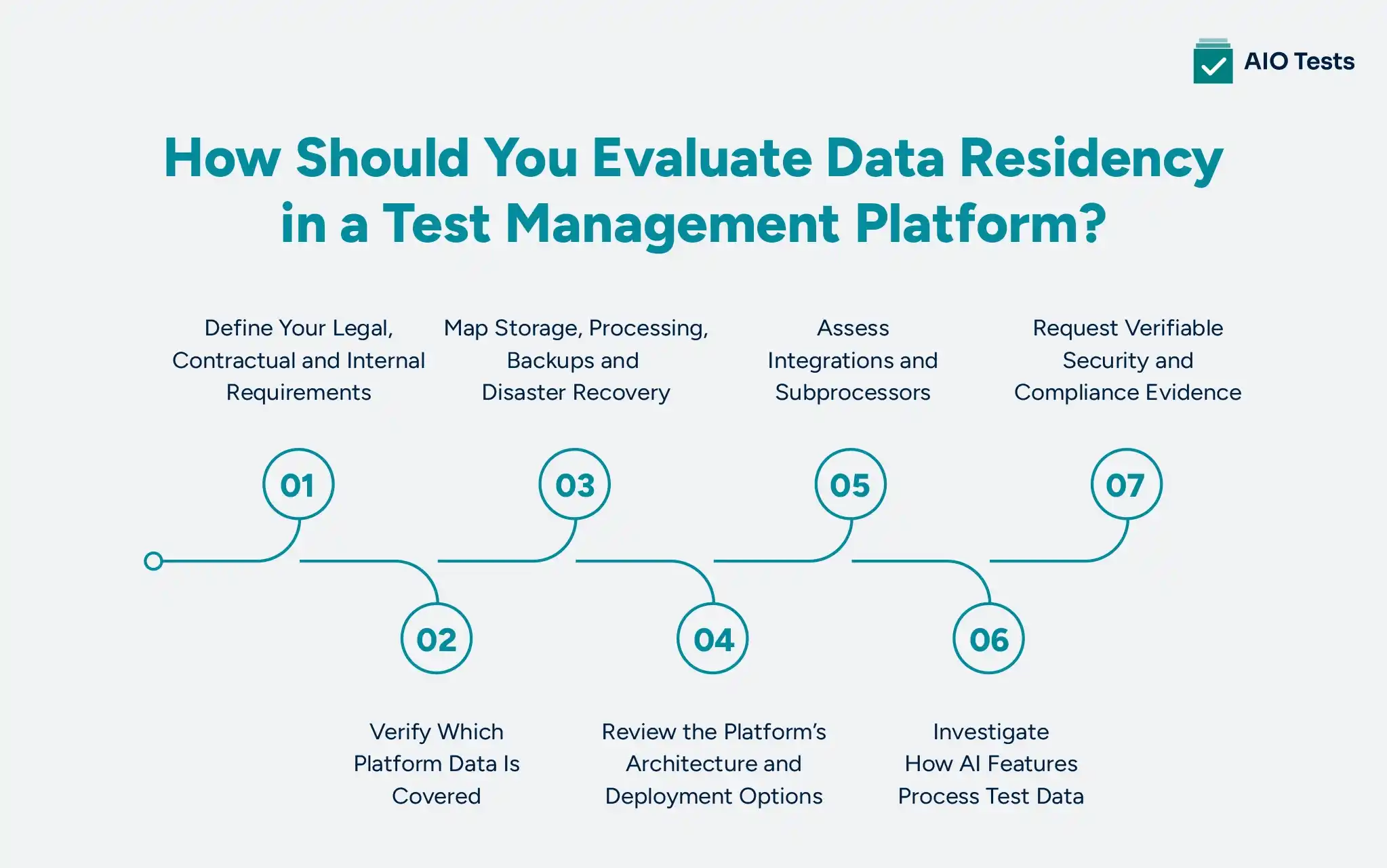
1. Define Your Legal, Contractual and Internal Requirements
Start with your own obligations rather than the vendor’s feature list.
Determine:
- Which test-data categories are regulated
- Which countries or regions are approved
- Whether restrictions cover storage, processing or both
- Whether personnel may access data from another country
- Which cross-border transfer mechanisms are acceptable
- Whether customers have promised a specific hosting location
- Which audit evidence must be available
The review should involve QA, engineering, security, legal, privacy, IT and procurement. A testing team may understand what evidence is collected, while a privacy team determines whether that evidence contains regulated information.
This step also prevents a common purchasing mistake: selecting a platform with EU hosting when the organization actually requires in-country processing, regional support restrictions or a self-managed deployment.
2. Verify Which Platform Data Is Covered
Ask the vendor to define its “in-scope data.”
The answer should distinguish between:
- Test cases
- Test plans and cycles
- Execution results
- Screenshots and attachments
- Defect information
- Audit records
- User profiles
- Caches
- Usage analytics
- Telemetry
- Support records
- AI prompts and outputs
A platform may store test cases in the selected region while processing analytics or operational logs elsewhere. “EU hosting” does not necessarily mean every category of customer-related information remains in the EU.
For Jira-based test management, review the Marketplace app separately from Jira. Atlassian explains that data residency applies to in-scope product data, while certain information, such as some logs, analytics and integration data, may be outside that scope. A third-party app can also operate its own hosted services.
3. Map Storage, Processing, Backups and Disaster Recovery
Storage location is only one part of cloud data residency.
Ask the vendor where information is:
- Stored
- Processed
- Replicated
- Cached
- Backed up
- Restored
- Archived
- Deleted
Backups and disaster-recovery environments deserve particular attention. The production database may be located in the EU while a recovery copy is maintained in another region. A failover event could also move processing outside the approved boundary.
Ask whether deleted records remain in backups, how long those backups are retained and whether old copies are moved when the customer changes regions.
A suitable test management platform should provide enough documentation for security teams to map these locations without relying on assumptions about the underlying cloud provider.
4. Review the Platform’s Architecture and Deployment Options
Different deployment models provide different levels of control.
- Multi-tenant SaaS: The vendor manages the infrastructure and offers supported regional options.
- Single-tenant cloud: The customer receives a more isolated environment, but regional availability still depends on the vendor’s architecture.
- Private cloud: The environment may provide greater network and infrastructure control.
- Self-managed or Data Center deployment: The customer controls infrastructure location, backups and access but also accepts more operational responsibility.
A major cloud provider may operate data centers in your preferred country, but this does not prove that the software vendor uses those facilities for every service.
Organizations using Jira should also establish whether a test management app stores data inside Atlassian services, in the app vendor’s infrastructure or across both.
5. Assess Integrations and Subprocessors
A compliant platform can still be connected to a service that moves data outside the approved region.
Map integrations with:
- Jira and other work-management tools
- CI/CD pipelines
- Test automation frameworks
- Source-code repositories
- Reporting platforms
- Communication tools
- Customer-support systems
- Cloud infrastructure services
Review the vendor’s subprocessor list. It should identify the organizations involved, the services they provide and the locations in which they process information.
Also determine how the vendor communicates changes. A new analytics, support or AI provider can change the platform’s data flow after the original assessment has been completed.
6. Investigate How AI Features Process Test Data
AI-assisted test creation introduces a separate processing route.
Requirements used to generate test cases may include product details, customer scenarios or internal acceptance criteria. Prompts may also contain information copied from Jira issues.
Ask the vendor:
- Which content is sent to the AI provider?
- Where are prompts and outputs processed?
- Are prompts or responses retained?
- Is customer data used to train models?
- Can the organization use its own AI account?
- Can AI features be disabled?
- Do all AI capabilities follow the same policy?
- Is sensitive information filtered before transmission?
Do not assume that the residency setting for the main application automatically applies to an external AI service. Each AI integration should be reviewed according to its provider, account configuration and applicable terms.
7. Request Verifiable Security and Compliance Evidence
Marketing claims should be supported by evidence.
Request:
- A Data Processing Agreement
- A current subprocessor list
- A data-flow diagram
- Applicable ISO certificates
- A SOC 2 report, where available
- Cloud Marketplace security disclosures
- Encryption documentation
- A data-retention and deletion policy
- An incident-response policy
- An access-control description
- A contractual residency commitment
Certifications such as ISO 27001 can show that the vendor maintains an information security management system. Marketplace trust programs can provide additional information about reliability and security practices. However, neither automatically proves that every type of customer data remains in a specific region.
The residency commitment should identify the covered data, locations and exceptions clearly enough to be verified during an audit.
What Questions Should You Ask a Test Management Vendor?
Use these questions during demos, security reviews and procurement discussions:
- Which data residency regions do you currently support?
- Which application data is included in the residency commitment?
- Which data categories are excluded?
- Where is customer data processed?
- Where are backups and disaster-recovery copies stored?
- Can vendor employees access customer data from other countries?
- Which subprocessors receive or process customer information?
- How do you notify customers about subprocessor changes?
- Where are audit logs, analytics and telemetry stored?
- What happens to data after deletion, uninstallation or termination?
- Can existing data be migrated to another region?
- Does a regional migration include attachments, backups and historical records?
- Where are AI prompts and outputs processed?
- Are AI inputs or outputs used for model training?
- Can customers use their own AI provider account?
- Which security reports and certifications are available?
- Is the residency commitment included in the contract or DPA?
Vendors should be able to answer these questions with product documentation, architectural evidence or contractual language. If the answers depend entirely on verbal assurances, the review is incomplete.
What Are the Red Flags When Comparing Test Management Platforms?
Be cautious when:
- The vendor names a cloud provider but not the regions used.
- Residency documentation does not define in-scope data.
- Storage is disclosed, but processing locations are not.
- Backups and disaster recovery are omitted.
- The subprocessor list is unavailable or outdated.
- AI processing is not documented.
- The platform cannot migrate existing data between regions.
- Support access is not governed by clear controls.
- Deletion timelines are missing.
- Certifications are presented as complete proof of residency.
- Marketing claims conflict with contracts or legal documents.
- The residency commitment is not included in an enforceable agreement.
These gaps do not always mean that a platform is unsuitable. They do mean that the buyer needs further evidence before approval.
How Does AIO Tests Support Enterprise Data Residency Requirements?
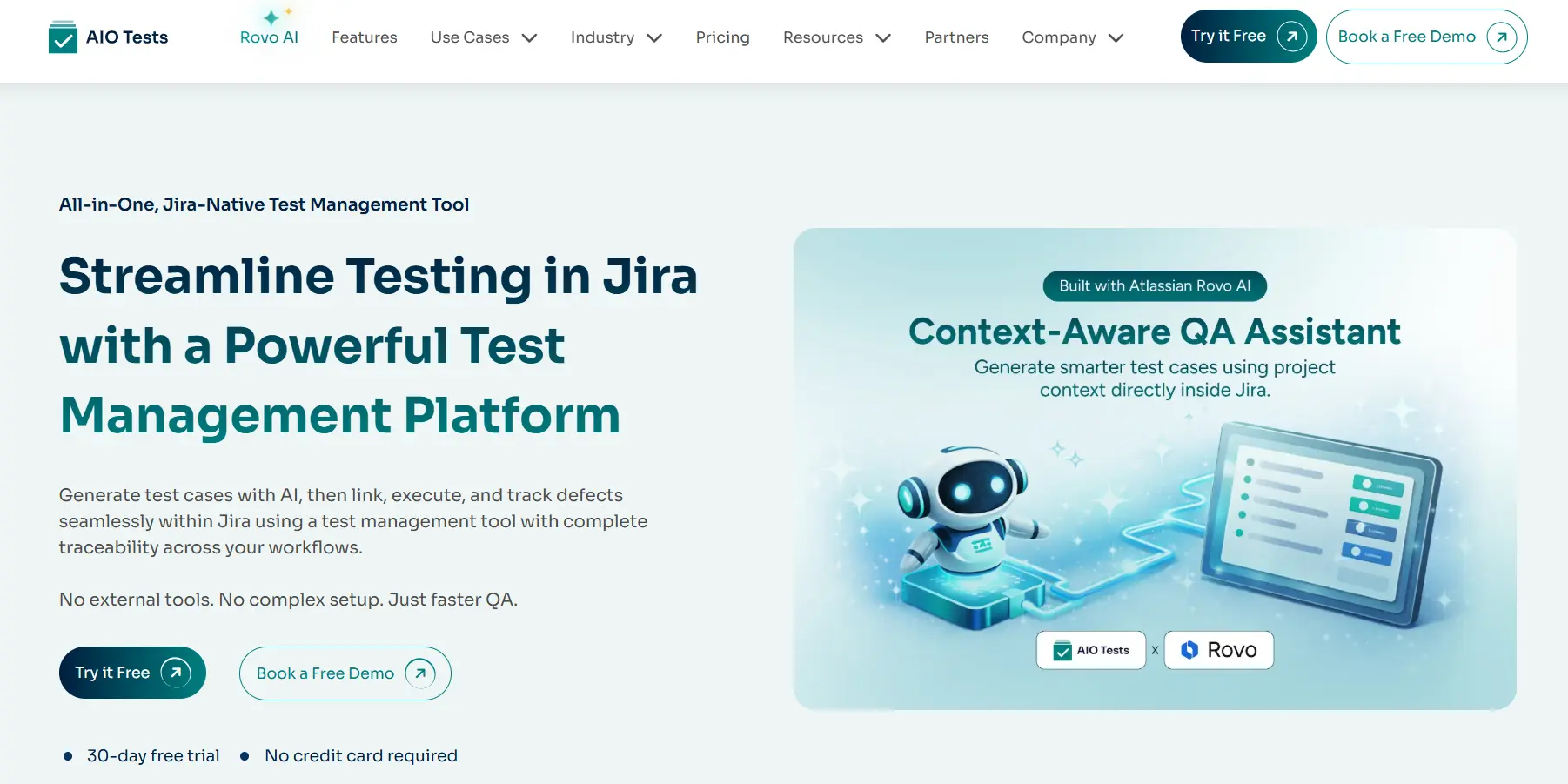
AIO Tests brings test-case creation, execution, automation reporting and traceability into a Jira-native workflow. The platform connects requirements, tests, results and defects, reducing tool switching while helping enterprise QA teams maintain an audit-ready traceability chain.
Jira-Native Test Management
The tool supports Classic and BDD/Gherkin test cases, manual and automated testing, defect linking, version control and more than 20 reports. Reports can be scheduled or exported in PDF and Excel formats. These capabilities are detailed on the features page and reporting page.
Deployment, Residency and Security
The Atlassian Marketplace listing confirms support for Jira Cloud and Jira Data Center. The application is also listed as Cloud Fortified, while the product website states that it is ISO 27001 certified and supports US and EU data residency.
However, the current Terms and Conditions state that customer data is stored in the United States. Enterprises should therefore confirm their available region, covered data, backup locations and processing scope directly with the vendor before purchasing.
Configurable AI Options
The platform allows customers to use vendor-provided OpenAI access or connect their own OpenAI or Azure AI account. Its terms state that prompts and generated responses are not stored by the platform.
The separate AIO Tests Rovo Assistant operates within Atlassian’s ecosystem, follows Jira permissions and does not use customer data for model training.
Who Should Consider the Platform?
The solution is suitable for Jira-based enterprises that need:
- Manual and automated test management
- Requirements-to-defect traceability
- Cloud or Data Center deployment
- AI-assisted test creation
- Xray or Zephyr migration support
- Centralized reports and dashboards
Organizations should make the final decision based on their required region, data classification, integrations and internal compliance review.
Conclusion
Data residency requirements cannot be evaluated through a hosting-region checkbox. Enterprise buyers must understand where test cases, attachments, automation results, logs, backups and AI inputs are stored, processed and accessed.
A strong platform evaluation combines legal requirements, technical architecture, subprocessor review and contractual evidence. It also considers how the platform supports daily QA work after the security review is complete.

FAQs
1. What Is Data Residency and Why Does It Matter for Enterprise Test Management?
Data residency refers to the geographic location where data is stored and processed. It matters because enterprise test repositories may contain personal data, production-like information, screenshots, API responses, and logs subject to regulatory or contractual requirements.
2. How Do Data Residency Requirements Affect Test Management Platforms?
Data residency requirements determine where a platform can store, process, replicate, and back up test data. Enterprises must also assess integrations, subprocessors, support access, and AI services that may transfer information outside the selected region.
3. What Data Residency Compliance Features Should Enterprises Look For?
Enterprises should look for supported hosting regions, clearly defined in-scope data, regional backups, controlled support access, encryption, retention policies, and subprocessor transparency. The vendor should also provide data-flow documentation and contractual evidence for its residency commitments.
4. How Does Data Localization Support Enterprise QA Compliance?
Data localization requires specified information to remain within a particular country or region. Enterprise QA teams can support it by selecting regional infrastructure and controlling where test evidence, integrations, backups, exports, and AI inputs are processed.
5. What Is the Difference Between Data Residency and Data Sovereignty?
Data residency concerns the geographic location where information is stored or processed. Data sovereignty concerns the laws and government authorities that can govern or access that information based on its location and the organizations handling it.
6. How Can Enterprises Verify Data Residency Before Choosing Test Management Software?
Enterprises should request the vendor’s data-flow diagram, subprocessor list, backup locations, retention policy, Data Processing Agreement, and contractual residency commitment. They should compare this evidence with the vendor’s security documentation and product claims before approving the platform.


.svg)
