

.webp)
Summarize Blog
Quick Summary
Most teams don’t struggle with automation itself, but with showing its true value through test automation ROI. By measuring savings versus investment and tracking the right automation ROI metrics, teams can reduce costs, speed up releases, and improve software quality assurance.
Most teams don’t fail at test automation. They fail at proving its value. When budgets tighten, and leadership asks hard questions, “We saved time” is not enough. What gets approved is test automation ROI backed by numbers that finance and engineering both trust.
At the buying stage, ROI stops being a QA metric and becomes a business decision. Leaders want to know how automation reduces cost per release, protects revenue from defects, and scales delivery without scaling headcount. If you cannot quantify those outcomes, your automation program stalls, no matter how mature it looks.
This guide focuses on how to calculate, validate, and present test automation ROI in a way that secures tooling buy-in and supports long-term automation scale.
What Is Test Automation ROI?
Test automation ROI (Return on Investment) measures the financial value and efficiency gained by using automation in software testing, compared with the total investment required to build, run, and maintain those tests.
In business terms, it answers a simple but critical question for stakeholders: “Are we getting more value back than what we’re spending?” — and by how much.
Core Principles of Test Automation ROI
- Quantifies returns vs. investment — expressed as a percentage that shows how much value automation delivers for every dollar spent.
- Compares automated vs. manual testing costs — factoring in savings from reduced manual effort and faster execution cycles.
- Includes quality and delivery improvements — such as defect reduction, earlier feedback loops, and shorter time-to-market that strengthen software quality assurance outcomes and add measurable ROI.
How Do You Calculate ROI for Test Automation?
At the buying stage, calculating ROI for test automation needs to be simple, defensible, and repeatable. The most widely accepted approach uses a straightforward formula that leadership immediately understands:
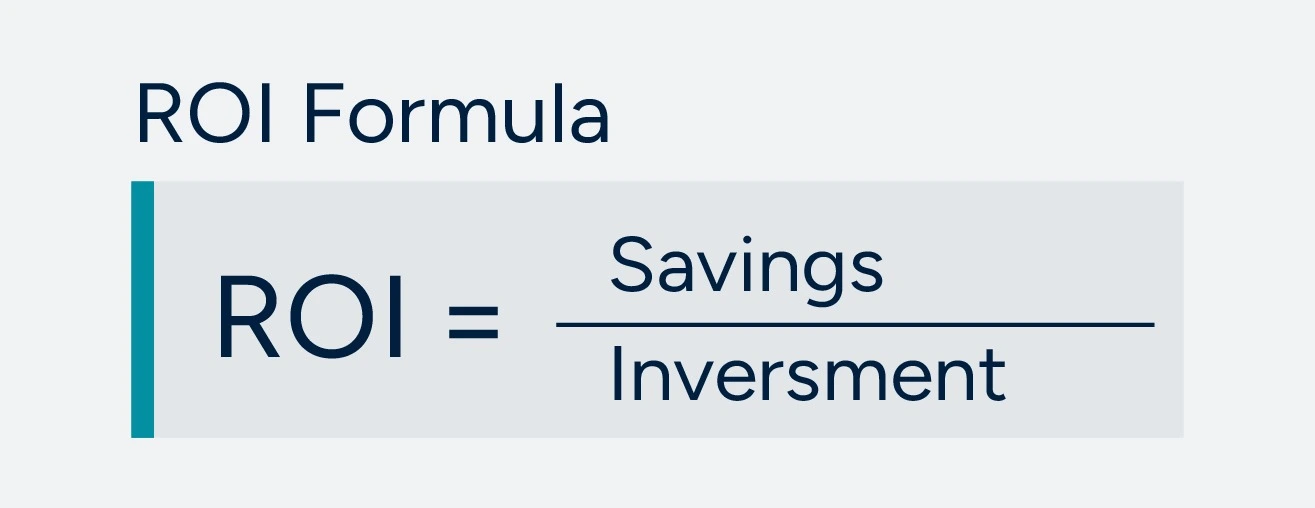
This calculation can be expressed in terms of cost, time, or both, depending on how your organization tracks value. What matters is consistency and clarity, not complexity.
In practical terms, ROI for test automation measures whether the savings generated by replacing manual testing with automation outweigh the total investment required to build, run, and maintain those tests.
What Costs Affect Test Automation ROI?
The ROI of test automation is heavily influenced by how accurately you account for investment. Underestimating costs is the fastest way to inflate ROI numbers and lose stakeholder trust.
Key cost components include:
- Initial framework and setup effort
Time spent designing, configuring, and integrating the automation framework into CI/CD pipelines.
- Test development effort
Time required to write automated test scripts, calculated as:
- Time to automate one test × number of automated tests
- Ongoing maintenance costs
Effort required to update tests as the application evolves, including:
- Fixing flaky or false-positive tests
- Updating scripts for UI or logic changes
- Debugging failures caused by real defects
- Failure-related maintenance overhead
Maintenance cost grows with instability and is calculated as:
- Maintenance time per failed test × failure rate × number of tests × number of test runs
As test suites scale over time, maintenance becomes the largest cost driver, which is why unstable automation directly delays positive ROI.
Which Automation ROI Metrics Matter Most?
Not all metrics strengthen an ROI case. At the decision stage, leaders care about metrics that translate directly into cost control, delivery speed, and risk reduction. The most effective automation ROI metrics do exactly that: they connect testing outcomes to measurable business impact.
The goal is not to track more metrics, but to track the right ones that stand up in budget reviews and tooling evaluations.
Which Cost Metrics Prove Test Automation ROI?
Cost metrics form the foundation of any credible ROI calculation. These metrics demonstrate whether automation is genuinely reducing spend or simply shifting effort.
Key cost-focused automation ROI metrics include:
- Manual effort reduction per release: Measures the number of human hours eliminated by automation and translates directly into cost savings.
- Cost per test execution: Compares the recurring cost of running automated tests versus manual tests across multiple cycles.
- Automation maintenance cost ratio: Tracks maintenance effort as a percentage of total automation effort. Lower ratios signal healthier ROI.
- Cost per defect detected: Shows how efficiently automation identifies defects compared to manual testing, especially in regression cycles.
- Total cost of ownership over time: Accounts for setup, test creation, infrastructure, and maintenance to avoid inflated ROI projections.
Which Delivery Metrics Improve Software Test Automation ROI?
Delivery metrics show how automation improves speed, stability, and release confidence, all of which contribute to long-term software ROI.
High-impact delivery metrics include:
- Regression cycle time reduction: Measures how much faster releases move once software regression testing is automated. Faster regression cycles reduce bottlenecks and help teams deliver more frequently.
- Release frequency improvement: Tracks how automation enables more frequent, reliable deployments without increasing testing effort.
- Defect escape rate reduction: Quantifies how many defects are caught before production, reducing post-release costs and customer impact.
- Test execution scalability: Assesses the ability to run larger test suites across environments without linear cost growth.
- Time-to-feedback for critical builds: Faster feedback reduces rework, improves developer productivity, and strengthens ROI indirectly.
Together, these metrics accelerate delivery while reducing risk, which is the strongest signal of mature, defensible software test automation ROI.
What Does Test Automation Return on Investment Look Like?
A realistic test automation return on investment is best understood by comparing manual and automated testing costs over a fixed period, using automated test management to track tests efficiently and ensure all results are measurable.
Below is a simple example using conservative assumptions.
Example: Manual vs Automated Regression Testing
- Manual execution time per test: 20 minutes
- Automated execution time per test: 2 minutes
- Number of regression tests: 300
- Regression runs per month: 8
Manual Testing Cost (Monthly)
- 300 tests × 20 minutes × 8 runs = 800 hours
- At $25 per hour → $20,000 per month
Automated Testing Cost (Monthly)
- 300 tests × 2 minutes × 8 runs = 80 hours
- At $25 per hour → $2,000 per month
Monthly Savings
$18,000 saved per month
Investment Costs
- Initial automation setup and test creation: $40,000
- Monthly maintenance cost: $4,000
Monthly Investment
- $4,000
ROI Calculation
- Net monthly benefit: $18,000 − $4,000 = $14,000
- Break-even period: ~$3 months
- ROI after 12 months:
- Savings: $216,000
- Total investment: $88,000
- ROI = 145%
This is what credible test automation return on investment looks like: clear cost reduction, fast break-even, and compounding value as test coverage and release frequency increase.
Which Tooling Choices Improve Automation ROI Metrics?
Tooling decisions are a major differentiator in making the ROI of test automation defensible in budget reviews.
The right qa testing tool can significantly reduce both the investment side (set-up and maintenance) and improve the benefit side (speed, coverage, stability).
Here’s how best-in-class tooling supports ROI:
- Unified test management and execution tracking
Test management app that blends manual and automated test workflows, eliminates silos, reduces duplication, and cuts the time teams spend reconciling test results, lowering operational costs.
- Seamless integration with development workflows
Tools that integrate directly with Jira and enable CI/CD for testing workflows help teams run automated tests continuously, reducing context-switching and accelerating feedback without increasing effort.
- Automation reporting and visibility
Dashboards and qa test reports that clearly show execution trends, defect counts, and coverage give stakeholders the real-time data they need to justify ROI, not just assumptions.
- AI-assisted test case generation and optimization
Platforms and AI testing tools that create and refine test cases automatically speed up test development and improve coverage without linear increases in manual effort, helping teams scale automation faster.
- Traceability from requirements to results
End-to-end traceability ensures teams aren’t wasting time on redundant tests and that every automated test ties back to business objectives and compliance, a key factor when presenting ROI to leadership.
For example, a modern QA management platform like AIO Tests centralizes manual testing and automated testing workflows, integrates with Jira for seamless requirements traceability, and offers automation reporting that makes ROI measurable rather than assumed.
By reducing test maintenance effort and improving execution visibility, such tooling directly accelerates break-even and amplifies the value delivered per release cycle, which are the core signals of high automation ROI.
Conclusion
Test automation only creates impact when test automation ROI is clearly measured and continuously optimized.
By tracking the right automation ROI metrics, understanding the true ROI of test automation, and aligning tooling with delivery goals, teams can turn automation into a business advantage rather than an ongoing cost.
For teams operating in Jira-centric environments, solutions like AIO Tests on Atlassian Marketplace support this approach by making automation results visible, traceable, and easier to justify at scale.

FAQs
- What is ROI in automation testing?
ROI in automation testing refers to the measurable return gained from automating tests compared to the total investment required to build, run, and maintain them. In practical terms, it shows whether test automation reduces costs, saves time, and improves delivery efficiency enough to justify the spend.
- What is the formula for test automation ROI?
The most commonly used and accepted formula for test automation ROI is:
ROI = Savings ÷ Investment
- Savings come from reduced manual testing effort, faster execution, and fewer defects reaching production.
- Investment includes framework setup, test creation, infrastructure, and ongoing maintenance costs.
This formula can be calculated using time, cost, or a combination of both.
- What are the 4 pillars of automation?
The four pillars of effective test automation that directly influence ROI are:
- Test design and coverage – focusing on high-impact, repeatable scenarios
- Tooling and framework stability – minimizing flakiness and maintenance effort
- Execution and integration – seamless CI/CD and frequent test runs
- Reporting and traceability – visibility into results, failures, and business impact
- How is ROI used?
ROI is used to evaluate whether automation efforts are delivering measurable business value. In automation testing, it helps teams justify tool purchases, prioritize automation scope, compare manual versus automated testing costs, and track when automation reaches break-even.


.svg)

