

.webp)
Summarize Blog
Quick Summary
Looking for the best Agile test management tools in 2026? This guide ranks and reviews ten platforms, including AIO Tests, Zephyr Scale, Xray, TestRail, and Qase.io, with feature breakdowns, pricing, pros, cons, and best-fit recommendations. Compare the options to find the test management tool that best fits your Agile team's workflow, testing needs, and budget.
More than half of Agile practitioners say testing is their biggest bottleneck to releasing faster. That's not a team problem. That's a tooling problem.
Most teams are sprinting in Jira but managing QA in spreadsheets or worse, a disconnected tool nobody fully uses. The result? Missed defects, zero traceability between requirements and test cases, and release delays that quietly kill sprint velocity.
The right QA test management tool changes all of that. It integrates your requirements, test cases, execution cycles, and defects into a single seamless workflow, so your team ships faster with confidence.
This guide ranks and reviews the top 10 agile test management tools in 2026 with real feature breakdowns, honest pros and cons, verified pricing, and a clear "Best For" verdict for every tool.
Let’s begin!
What Makes The Best Agile Test Management Tools in 2026?
Before we get to the list, here are the 5 criteria we used to evaluate every tool on this page and the ones you should use, too.
1. Jira-Native vs. Jira-Integrated
Not all Jira connections are equal. A tool that's truly Jira-native lives inside Jira, no syncing, no tab switching, no context loss. A tool that's merely "Jira-integrated" connects from the outside, which means sync delays, duplicate data entry, and broken traceability the moment something goes out of sync.
2. AI-Powered Test Case Generation
Manually writing every test case from scratch is a sprint-velocity killer in 2026. The best agile testing tools now automatically generate test cases from your Jira requirements using Gen AI, saving your team hours in every sprint. Look for tools where AI is context-aware, not just a generic prompt box.
3. BDD + CI/CD + Automation Framework Support
Shift-left QA means your test tool must speak the same language as your developers. Native BDD/Gherkin support, seamless CI/CD pipeline triggers, and plug-and-play reporters for Cucumber, Cypress, and Jenkins are non-negotiables for any serious Agile team. If your tool makes automation reporting feel like extra work, it's the wrong tool.
4. Sprint-Aligned Reporting
Your stakeholders shouldn't be chasing test status updates on Slack every Monday morning. The best test management software for agile teams delivers burndown charts, traceability reports, and automated stakeholder updates on a schedule without anyone lifting a finger. Real-time visibility into sprint progress is what separates high-performing QA teams from reactive ones.
5. Scalable, Transparent Pricing
Per-user pricing that multiplies with every new hire is a CFO's nightmare. Look for flat or team-based pricing with a free entry point so you can prove value before committing budget. The best tools in 2026 scale with your team without sending your monthly invoice through the roof.
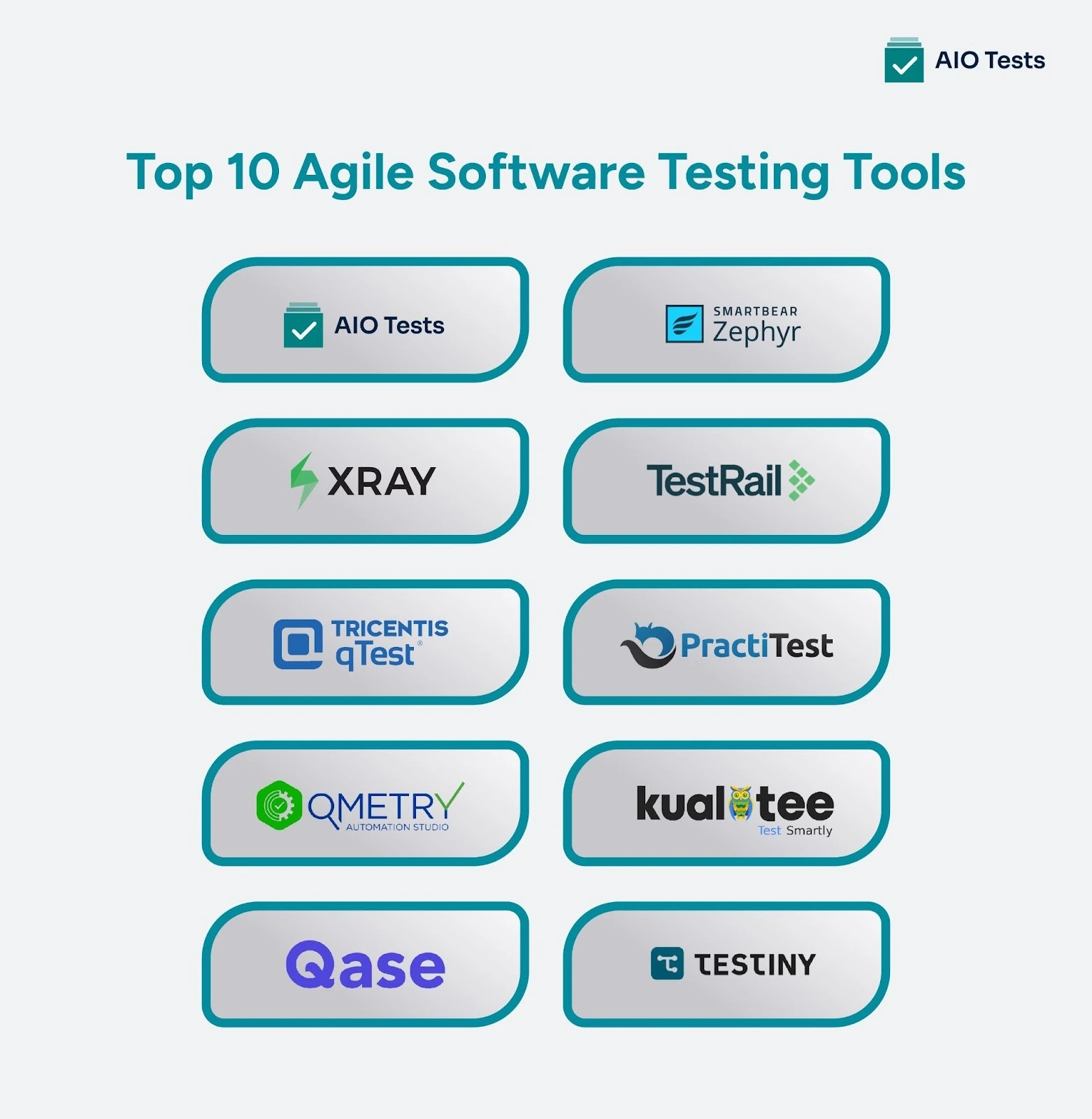
Top 10 Agile Software Testing Tools
Quick Comparison Table
Here's a side-by-side snapshot of all 10 tools before the deep dives. Use this table to shortlist, then read the full review for your top picks.
1. AIO Tests - Best Agile Test Management Tool

Overview: AIO Tests is a 100% Jira-native, all-in-one Agile Test Management platform built for Agile teams that want full traceability, AI-powered test case generation, and seamless execution, all without leaving Jira. It's not just another tool that "integrates" with Jira. It lives entirely inside it.
Built by an Atlassian Platinum Partner, AIO Tests gives QA teams everything they need from creating AI-generated test cases linked directly to Jira requirements to tracking defects, managing execution cycles, and delivering automated stakeholder reports.
- AI-Assisted Test Case Generation: Stop writing test cases manually. AIO Tests generates detailed, sprint-ready test cases directly from your Jira requirements in classic or BDD style in seconds.
- Cases: Every test case your team will ever need, organized inside Jira. Full version control, linked cases, and one-click import from Excel, CSV, and feature files, zero migration headaches.
- Cycles: You can run, track, and close test cycles without leaving Jira. Defects auto-populate into Jira bug reports the moment a test fails, no manual logging, no wasted sprint time.
- Reports and Analytics 20+ + real-time reports delivered automatically to your stakeholders on your schedule. Pass/fail rates, defect trends, and full traceability, all without a single manual update.
- Automation and CI/CD Integrations: Cucumber, Cypress, Katalon, JUnit, TestNG, Newman AIO Tests plug into your existing automation stack without friction. One REST API connects your entire CI/CD pipeline to your test results.
Pricing
- Free for up to 10 users
- Standard: For 11 users - $21.78/month
- 30-day free trial - no credit card required
Pros
- 100% Jira-native zero context switching, zero sync errors, zero additional vendor logins.
- Most cost-effective at scale, up to 94% cheaper than TestRail for a team of 100.
- Free plan for up to 10 users, the strongest free entry point on this entire list.
- Rovo AI Assistant and Gen AI deliver the most advanced AI test generation layer available in 2026.
Cons
- Built exclusively for Jira teams, AIO Tests cannot be used by teams that do not use Jira.
- Advanced Rovo AI features require an active Atlassian Rovo subscription.
Best For
Agile and Scrum teams already working in Jira who want a complete, AI-powered QA platform with zero additional tools, zero per-user pricing surprises, and a free plan to get started today.
2. Zephyr Scale

Overview: Zephyr Scale is a Jira-native test management add-on by SmartBear. It works inside Jira and supports test case creation, execution, and basic reporting. It's been around for a while and has a familiar user base among Jira teams. However, it lacks the depth of AI features and execution planning that modern Agile teams increasingly expect.
Key Features
- Test case creation and execution inside Jira
- Parameterized testing (Scale edition only)
- Cross-project test case reuse
- Basic Agile reporting dashboards
- Upgrade path from Squad to Scale to Enterprise
Pricing
- Need to connect with the Zephyr scale to know exactly about their pricing.
- Scale: custom pricing
- Enterprise: custom pricing
- No free plan available
Pros
- Familiar interface for existing Jira users
- Scalable edition structure
- Decent community and documentation
Cons
- Per-user pricing gets expensive quickly at scale
- Limited AI capabilities compared to newer tools
- Performance issues reported at high test volumes
- No free plan for small teams
Best For Mid-to-large Jira teams looking for a familiar, established native test management solution.
If you wanted to try some alternatives to Zephyr, check out this blog: The Best Alternatives to Zephyr.
3. Xray
Overview: Xray is a Jira-native test management tool with a strong focus on BDD and behavior-driven development. It allows teams to write Gherkin scenarios inside Jira and link them to requirements. It's a reasonable choice for BDD-heavy teams but offers limited value outside of that specific use case.
Key Features
- Native BDD/Gherkin support inside Jira
- Manual and automated testing in one interface
- Requirements traceability
- Automation result imports
- CI/CD integrations via Jenkins and Bamboo
Pricing
- Up to 10 users: $100/year
- Data Center: tiered by user count
- No free plan available
Pros
- Strong BDD and Cucumber integration
- Good traceability from stories to test execution
- Decent automation framework support
Cons
- Jira-only, no standalone option
- Steep learning curve for X-ray-specific issue types
- Limited AI capabilities
- No standalone requirements management module
Best For Development teams practicing BDD with Cucumber and Selenium stacks who need requirement-to-execution traceability inside Jira.
4. TestRail
Overview: TestRail is one of the older, widely used standalone test management platforms. It works alongside Jira via an external integration, not natively inside it. While it has a large user base and solid documentation, it hasn't kept pace with modern Agile teams' expectations around AI, automation, reporting, and sprint-aligned workflows.
Key Features
- Hierarchical test suites with case reuse
- Milestone-based test planning
- Role-based permissions and SSO
- Real-time reporting across runs and milestones
- Integration with major automation frameworks via API
Pricing
- Professional Cloud: ~$35/user/month
- Enterprise Cloud: ~$76/user/month
- Self-hosted option available
- No free plan; 30-day trial only
Pros
- Large established user base
- Works across multiple project management tools
- Flexible methodology support
Cons
- External Jira integration is not native, and sync lag is common
- Expensive at scale, 100 users cost ~$3,500/month
- Aging UI that feels click-heavy
- No free plan
Best For Teams not fully committed to Jira, who need a standalone, battle-tested test management platform.
5. Tricentis qTest

Overview Tricentis qTest is a test management platform built for large organizations with complex DevOps pipelines. It supports manual, exploratory, and automated testing across multiple methodologies. While feature-rich, it comes with a heavy price tag, significant setup complexity, and admin overhead, making it impractical for lean Agile teams.
Key Features
- qTest Manager, Insights, and Launch modules
- 60+ pre-built reports and custom dashboards
- Cross-project test case reuse with version control
- Agentic AI for test case generation
- Event-driven workflow builder
Pricing
- Request Tricentis qTest pricing
- No free plan available
Pros
- Scales well for large, complex test portfolios
- Strong analytics and reporting depth
- Supports Agile, waterfall, and hybrid methodologies
Cons
- Expensive and complex for small or mid-size teams
- Jira integration is sync-based — not native
- Heavy admin overhead required
- No transparent public pricing
Best For Large enterprises with dedicated QA operations, compliance requirements, and complex multi-team DevOps pipelines.
6. PractiTest
Overview: PractiTest is a cloud-based test management platform that centralizes requirements, test cases, and defects. It offers deep customization and SmartFox AI for test improvement suggestions. However, it's cloud-only, carries a high per-user price tag, and its aging interface adds friction for teams looking for a modern, fast QA workflow.
Key Features
- Hierarchical filter trees for data organization
- SmartFox AI for test improvement and defect pattern detection
- Reusable test components across projects
- Customizable dashboards and real-time reporting
- REST API, xBot, and FireCracker for automation integration
Pricing
- $49 - User/Month
- No free plan; 14-day trial only
- Cloud-only deployment
Pros
- Highly customizable workflows
- Strong reporting and BI layer
- SOC2 and ISO 27001 certified
Cons
- Cloud-only — no on-premise option
- Aging UI with a notable learning curve
- Expensive for growing teams
- Filter-based navigation takes time to master
Best For Mid-to-enterprise QA teams in regulated industries needing deep customization, compliance certification, and detailed reporting.
7. QMetry
Overview: QMetry is an AI-enabled quality management platform for Agile and DevOps teams. It includes a codeless automation studio and intelligent test prioritization features. While it has a solid AI layer, its lack of pricing transparency, lack of external Jira integration, and complex setup make it less accessible to teams that want a quick, straightforward onboarding experience.
Key Features
- AI test case generation and intelligent search
- QMetry Automation Studio codeless scripting
- Flaky test detection and auto-prioritization
- End-to-end traceability
- Customizable dashboards with quality metrics
Pricing
- Custom pricing contact sales required
- Cloud and on-premise options available
- No free plan is publicly available
Pros
- Strong AI-driven test analytics
- Codeless automation lowers the barrier for non-technical testers
- Supports both cloud and on-premise deployment
Cons
- No transparent public pricing
- External Jira integration is not native
- Complex setup for smaller teams
- Steep learning curve for non-technical users
Best For Automation-heavy Agile QA teams at mid-to-large organizations needing AI-guided test prioritization and codeless automation capabilities.
8. Kualitee

Overview: Kualitee is a test management platform with a built-in AI assistant called Hootie. It supports Agile, waterfall, and hybrid methodologies with both cloud and on-premise options. It's affordable and accessible for smaller teams, but its limited scalability and smaller ecosystem make it a less compelling choice as your team and test portfolio grow.
Key Features
- Hootie AI for test case generation and defect analysis
- End-to-end test lifecycle management
- Sprint-wise testing dashboard
- Requirement mapping with traceability
- Cloud and on-premise deployment options
Pricing
- $12/user/month
- Annual discount available
- 7-day free trial
- No permanent free plan
Pros
- Most affordable tool with AI features in this list
- On-premise option at a low price point
- Simple, clean interface for quick onboarding
Cons
- Limited scalability for 500+ user organizations
- Smaller community and integration ecosystem
- External Jira integration is not native
- Reporting depth is basic compared to enterprise tools
Best For SMBs and budget-conscious Agile teams that need AI-assisted test management with on-premise flexibility at an accessible price.
9. Qase.io

Overview: Qase is a modern cloud-based test management tool popular among startups and lean development teams. It has a clean interface, a growing AI layer, and a free tier for up to 3 users. While it's easy to get started with, it's cloud-only, lacks the depth of enterprise tools, and its per-user pricing scales up quickly for teams beyond 10 people.
Key Features
- AI-powered test case generation and step suggestions
- Clean, modern interface for test plans and runs
- Lightweight defect tracking with requirements traceability
- Two-way sync with Jira, GitHub, GitLab, and Trello
- Slack and Microsoft Teams notifications
Pricing
- Free: up to 3 users
- Plus: $24/user/month
- Business: $30/user/month
- Enterprise: custom pricing
Pros
- Best UI/UX in this list for ease of use
- Generous free tier for very small teams
- Fast setup under 30 minutes
Cons
- Cloud-only, no on-premise option
- Per-user pricing becomes costly for growing teams
- Less feature depth for complex QA workflows
- External Jira sync is not native
Best For Startups, lean development teams, and solo QA engineers who need fast, modern, affordable test management with a clean interface.
10. Testiny
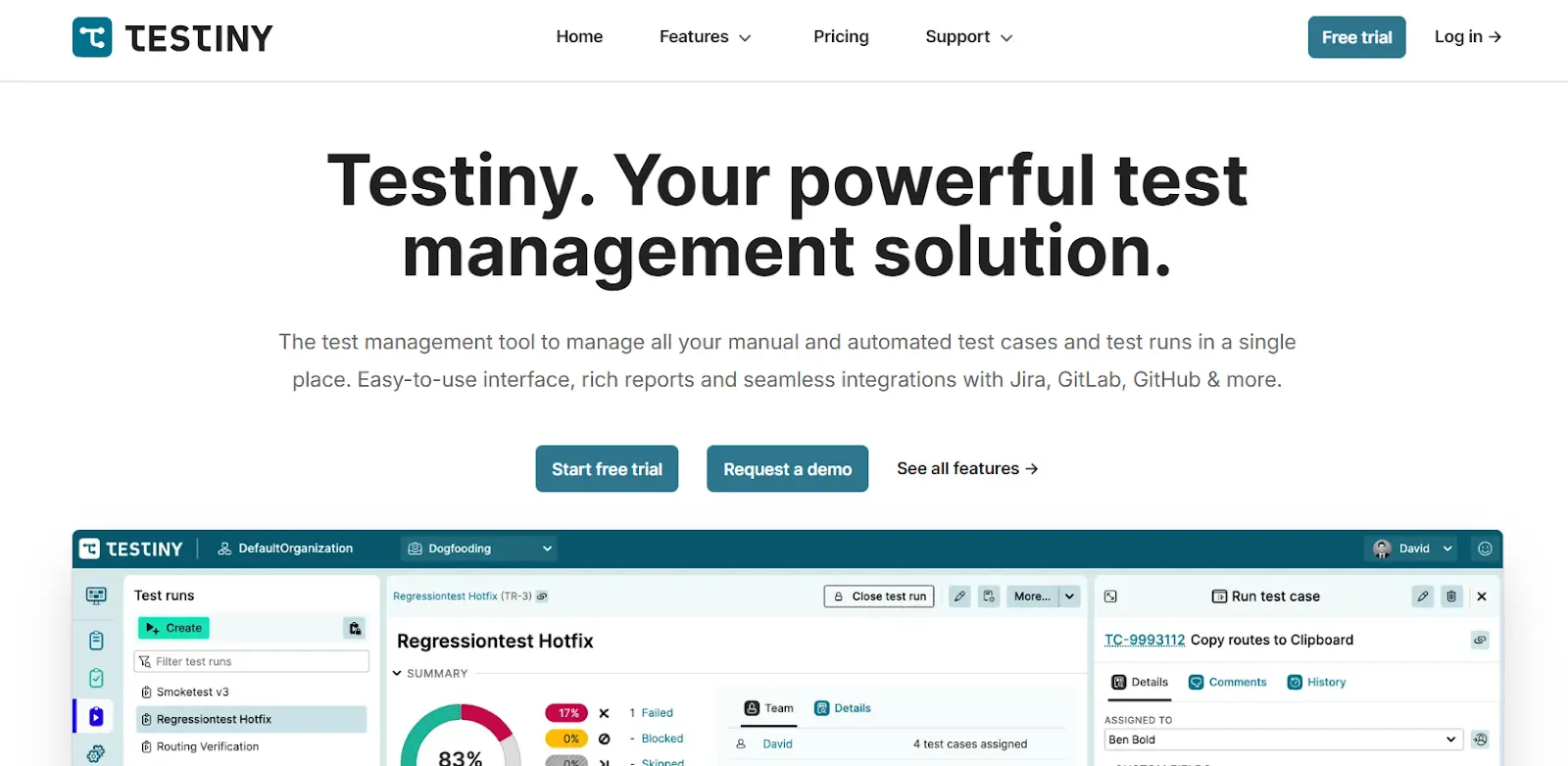
Overview: Testing is a lightweight, open-source test management tool built for small Agile teams. It offers real-time collaborative editing and a free tier for open-source projects. While its collaboration features are genuinely strong, it has limited reporting depth, a small integration ecosystem, and lacks the enterprise-grade features that scaling QA teams will eventually need.
Key Features
- Real-time collaborative test case editing
- Drag-and-drop test run assembly
- Customizable test templates and precondition fields
- CSV import with Jira requirement linking
- Testing Runner for automation result reporting
Pricing
- Free for open-source and non-profit projects
- Paid plans start at $ 18.50
- 21-day free trial for paid plans
- No on-premise option
Pros
- Real-time collaboration is genuinely strong
- Free tier for open-source projects
- Clean, modern interface with minimal learning curve
Cons
- Limited reporting depth
- Small integration ecosystem
- Not suitable for large QA operations
- No on-premise deployment option
Best For Small Agile teams, open-source contributors, and indie developers who need lightweight, real-time collaborative test management at minimal cost.
Conclusion
In 2026, Agile teams can no longer afford to treat QA as an afterthought. The tools on this list represent the best the market has to offer from enterprise giants like Tricentis qTest to lean, modern platforms like Qase.io and Testiny. Every tool here solves a real problem. The question is which one solves yours.
But if your team already works in Jira, the decision is straightforward. AIO Tests is the only tool that combines true Jira-native architecture, advanced Gen AI + Rovo Assistant, full BDD support, 20+ automated reports, and the most competitive pricing in the market, including a permanent free plan.
It's the only tool where your entire QA workflow lives inside your existing Jira environment with zero context switching, zero extra vendor relationships, and zero per-user price shock.
Book a demo today to explore more about AIO Tests.

Frequently Asked Questions
1. What are agile test management tools, and why does every Agile team need one?
Agile test management tools are platforms built to plan, execute, and track software testing within rapid sprint cycles. Unlike spreadsheets or legacy tools, they integrate with Jira, support BDD, connect to CI/CD pipelines, and deliver real-time sprint-aligned reporting. Without one, most Agile QA teams operate in silos, requirements disconnected from test cases, defects disconnected from sprints, and release quality left to chance.
2. What's the difference between agile testing tools and traditional test management tools?
Traditional test management tools were designed for waterfall methodology, long release cycles, heavy documentation, and sequential execution. Agile testing tools are built for speed and continuous delivery, prioritizing Jira integration, sprint-by-sprint execution cycles, and automated stakeholder reporting. The biggest practical difference is that time agile tools reduce the gap between "test case written" and "defect logged in Jira" from hours to minutes.
3. Which is the best agile test management tool for Jira teams in 2026?
AIOTests is the top-rated agile test management tool for Jira teams in 2026, the only 100% Jira-native platform combining Gen AI, Rovo Assistant, BDD support, and 20+ automated reports in one place. With 4,200+ customers, 200,000+ active users, and a perfect 4/4 rating on the Atlassian Marketplace, it consistently outperforms alternatives on value and feature depth. For Agile teams already in the Jira ecosystem, it's the clear first choice.
4. What should I look for when evaluating test management software for agile teams?
Focus on five criteria: Jira-native architecture, AI-powered test case generation, BDD and CI/CD support, sprint-aligned automated reporting, and transparent team-based pricing. Tools that check all five eliminate the most common QA bottlenecks Agile teams face every sprint.
5. Are there free agile software testing tools available in 2026?
AIOTests offers a permanent free plan for up to 10 Jira users with full features included, Qase.io offers free access for up to 3 users, and Testiny has a free tier for open-source projects. Among these, AIOTests provides the most comprehensive free feature set, including AI test generation, BDD support, execution cycles, and full reporting.


.svg)

