

Summarize Blog
Quick Summary
Evaluating a software quality management system for requirements traceability? This guide gives QA leads the key criteria to verify before committing, including real-time bidirectional traceability, native Jira integration, execution-linked reporting, and CI/CD traceability. Use the practical vendor checklist to identify the capabilities that matter and spot where quality management platforms may fall short.
Your team is in Jira. Requirements exist. Test cases exist. But the moment a stakeholder asks, "Are all requirements covered for this release?" the honest answer is a slow exhale. That is not a process failure. It is a tooling failure. Most teams discover this 48 hours before a release, by which point it is too late to fix cleanly.
You are not here to learn what requirements traceability is. You are here to find out which software quality management system actually delivers it, and which ones quietly hand you a spreadsheet and call it done.
This post gives you six criteria to verify before you sign anything.
Why Most Quality Management Software Fails the Traceability Test Before You Even Notice?
The gap between "has traceability" and "does traceability automatically" is where most platforms fail. These are not the same thing, and vendors rarely distinguish between them in a demo.
Jira holds your requirements. Most external quality management software pulls from Jira but lives outside it, which means every report runs on a sync. By the time the RTM lands in front of a QA lead, the data is already stale. A requirement changed this morning. The report does not know that yet.
The real test is simple: can a QA lead generate a live, accurate requirement-to-test-case-to-defect report in under 60 seconds without exporting anything? Most platforms cannot pass it. If yours cannot either, you are not running traceability. You are running a documentation ritual.
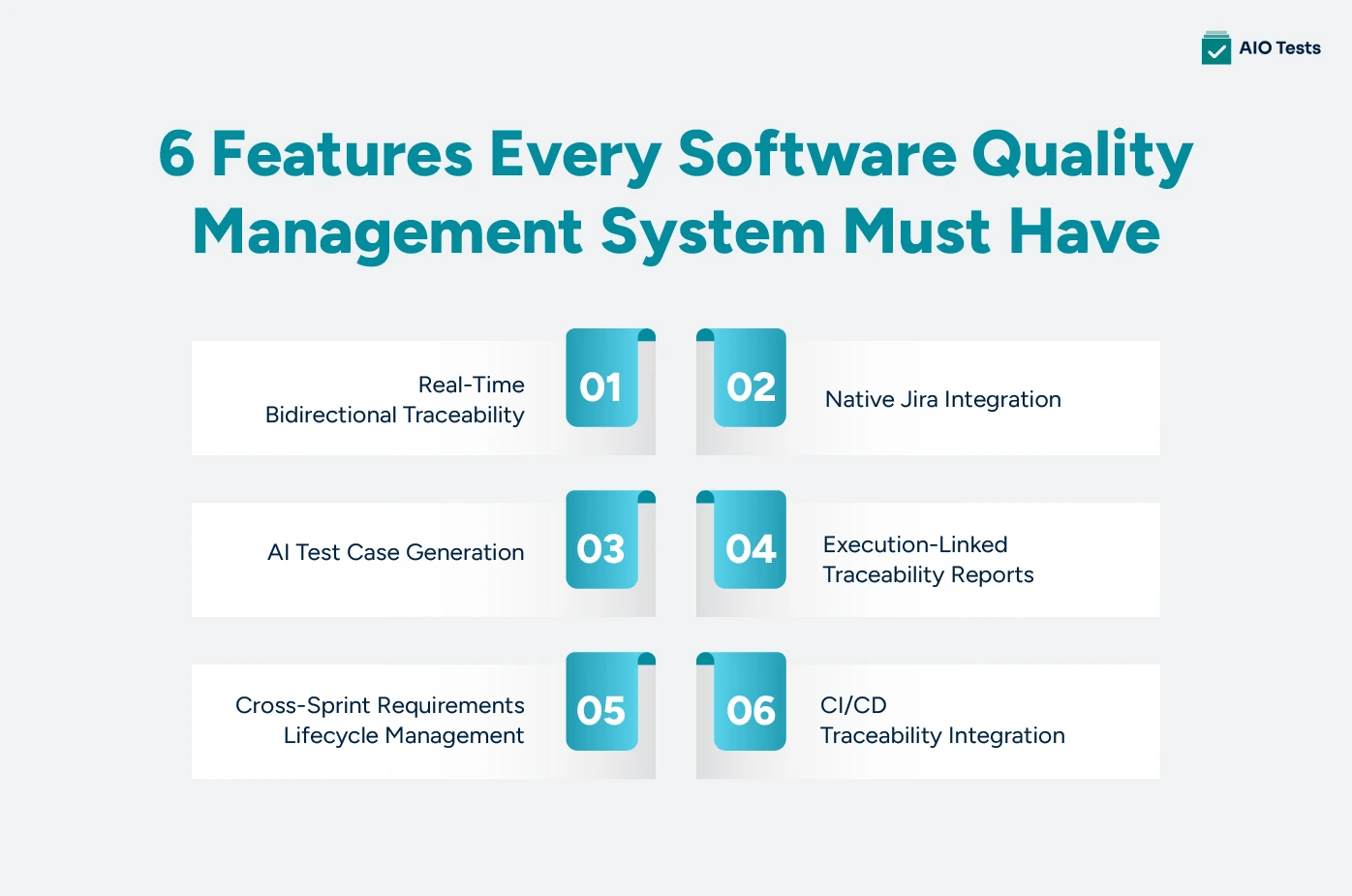
6 Features Every Software Quality Management System Must Have
Ask every vendor on your shortlist to demonstrate these six features specifically, not in a scripted walkthrough, but against a real requirement in your environment.
1. Real-Time Bidirectional Traceability
Bidirectional traceability means requirements link forward to test cases, and test cases link back to requirements. When a requirement changes mid-sprint, the system automatically flags affected test cases without anyone needing to run a manual check.
What to verify in the demo: Does the RTM update the moment a requirement is edited, or do you have to regenerate it manually? If the answer is "regenerate," that is a spreadsheet with a better UI.
The outcome this delivers: You stop discovering three days after a requirement changed, when a block of test cases was written against the old version.
2. Native Jira Integration
Native Jira integration means the tool lives inside Jira as a first-class app, not a third-party product that pulls data on a schedule. The distinction matters more than most buyers realize during evaluation.
What to verify: Can a QA engineer link a Jira epic, story, or task directly to a test case without leaving the Jira interface? If the answer involves logging into a second platform, opening a separate dashboard, or waiting for a sync to complete, the integration is not native. It is a connector.
The outcome this delivers: zero context switching, zero sync lag, and one source of truth shared by both development and QA.
3. AI Test Case Generation
AI test case generation is becoming a standard claim. The distinction between useful and cosmetic is whether the AI reads the actual Jira requirement or a QA engineer has to copy and paste the requirement text into a separate prompt.
What to verify: Open a Jira user story in the demo environment and ask the AI to generate test cases from it directly. Watch whether the tool reads the story content automatically or waits for manual input.
The outcome this delivers: Test coverage starts the moment a requirement is written, not after a QA engineer manually authors cases from a document that may already be three revisions old.
4. Execution-Linked Traceability Reports
A traceability report that only shows whether a test case exists for a requirement is not a traceability report. It is a coverage map. The decision-grade report shows requirements, linked test cases, execution result (pass, fail, not run), and any open defects, in a single view.
What to verify: Ask the vendor to generate a report for a specific sprint or release that shows all four data points in a single report, without switching modules. If defects are in a separate section, the report is incomplete.
The outcome this delivers: Release decisions made on live data, not assembled from three separate exports stitched together the night before go-live.
5. Cross-Sprint Requirements Lifecycle Management
Requirements change. In Agile environments, changes occur frequently, sometimes mid-sprint. A platform that tracks a requirement only at a point in time is not built for this reality.
What to verify: Does the system maintain version history for requirements? When a requirement is updated, does the platform alert the team that linked test cases may no longer reflect the current spec?
The outcome this delivers: Agile teams stay traceable at sprint velocity. Traceability does not become a release-gate scramble because the system has been continuously tracking changes, not just at snapshot time.
6. CI/CD Traceability Integration
Automated tests may run on every build. But if those results do not feed into the traceability matrix, they are invisible to the RTM. From a release, confidence, and audit standpoint, a test that ran but did not trace back to a requirement effectively did not happen.
What to verify: Ask whether automated results from Jenkins, GitHub Actions, Playwright, Cucumber, or the team's specific framework appear in the same traceability report as manual results. If they are in a separate automation module, dual-tracking is required, and coverage gaps become likely.
The outcome this delivers: One unified coverage view across manual and automated testing, with no separate reconciliation step required before a release.
Software Quality Management System Feature Checklist: What to Ask Every Vendor
What’s Next?
Requirements traceability is not a documentation exercise. It only works if the data behind it is live, automated, and scoped to the exact sprint or release a team is shipping.
The checklist in this blog is not a wish list. It is the minimum bar. Every software quality management system on your shortlist should pass it in a live demo, against real requirements, before you commit.
While requirements traceability is often framed as a function of software quality management systems, most teams end up building it inside a dedicated test management platform instead.
For teams working in Jira, AIO Tests delivers that end-to-end traceability by linking requirements, test cases, test executions, and defects in one continuous workflow.
Try AIO Tests for Free and experience smarter.

FAQ
Q1. What role does software quality assurance play in requirements traceability?
Software quality assurance depends on traceability to confirm that every requirement has been tested before a release ships. Without a direct link between requirements and test cases, QA teams cannot prove coverage, and defects slip through undetected. Traceability turns software quality assurance from a checklist exercise into a verifiable, audit-ready process.
Q2. What should requirements management software do beyond storing requirements?
Requirements management software should connect every requirement to its test cases, execution results, and linked defects in a single live view. Storing requirements is the baseline; the real value comes from tracking whether each requirement has been tested, what the result was, and whether any defects were raised against it. Without that chain, requirements management software is a documentation tool, not a quality tool.
Q3. How does requirements lifecycle management work in Agile sprints where requirements change frequently?
Requirements lifecycle management tracks every change made to a requirement from the moment it is written through every sprint it evolves across. When a requirement is updated mid-sprint, the system flags all linked test cases for re-evaluation before the next execution cycle. This prevents teams from shipping against stale test coverage without realizing the requirement they tested against no longer reflects what was built.
Q4. What should a QA lead verify in a demo before choosing quality management software for traceability?
Ask the vendor to generate a live traceability report scoped to a specific sprint or release, showing requirements, linked test cases, execution status, and defects in a single view without exporting anything. Then update a requirement mid-demo and check whether the linked test cases flag automatically or require a manual check to identify the impact. If either step requires an export or a manual workaround, the tool is not built for real traceability.
Q5. Does quality assurance software need to support both manual and automated tests in the same traceability report?
Yes. A traceability report that only reflects manual test results gives an incomplete picture of actual requirement coverage. Automated tests running in a CI/CD pipeline cover a significant portion of the test suite, and if those results do not appear in the same RTM as manual results, teams make release decisions based on partial data. Quality assurance software that siloes automated and manual results forces dual-tracking, which defeats the purpose of having a traceability system at all.


.svg)
