

.webp)
Summarize Blog
Quick Summary
A rovo agent is an AI-powered assistant within Atlassian’s ecosystem that transforms Jira automation by enabling intelligent, context-aware workflows, reducing manual effort, improving decision-making, and driving scalable enterprise productivity across Jira and Confluence.
A rovo agent is part of Atlassian’s growing AI ecosystem, designed to bring intelligence and automation directly into tools like Jira and Confluence. Instead of relying only on static rules or manual workflows, these AI agents can understand context, take actions, and support teams in real time.
This shift represents a major evolution in Jira automation. Traditional automation was rule-based and rigid. Now, with AI-powered systems, workflows are becoming adaptive, context-aware, and significantly more efficient.
For teams exploring modern DevOps and Agile practices, this marks a transition toward AI-driven productivity. It’s not just about automating tasks anymore; it’s about intelligent decision-making inside workflows.
At the center of this transformation is Rovo AI, which powers smarter systems across Atlassian tools, reshaping how teams manage work, track issues, and collaborate at scale. The real question today is how enterprise AI agents are reshaping workflows inside Jira.
What Is a Rovo Agent?
A rovo agent is an AI-powered assistant built within the Atlassian ecosystem that helps teams automate tasks, retrieve insights, and manage work more efficiently inside tools like Jira and Confluence.
Unlike traditional automation tools that rely on predefined rules, a Rovo agent can understand context and respond intelligently to user needs. It can assist with decision-making, perform workflow actions, and reduce repetitive manual effort.
At its core, a Rovo agent is part of Atlassian’s broader AI strategy. It is designed to serve as a digital teammate for developers, project managers, and business teams.
This positions Rovo agents within the growing category of AI agents in enterprise tools,systems that don’t just execute commands but actively assist in managing complex workflows.
Rovo AI and Its Role in the Atlassian Ecosystem
Rovo AI represents the intelligence layer that powers search, chat, and AI agents across Atlassian tools.
- It connects Jira and Confluence into a unified intelligent system where knowledge and actions are no longer isolated. Instead, Rovo AI enables teams to access information, automate tasks, and trigger workflows from a single AI-driven interface.
- Within this ecosystem, Jira becomes more than a tracking tool, and Confluence becomes more than documentation. Together, they operate as connected systems powered by AI.
- The key idea is simple: Rovo AI acts as an AI layer across Atlassian tools, enabling seamless automation and smarter decision-making across the entire workflow lifecycle.
Key Benefits Of Using Rovo Agent In Jira

Faster Workflow Execution
Rovo Agent helps teams execute workflows more quickly by reducing delays caused by manual steps and approvals. It enables smoother task progression across Jira projects, improving overall delivery speed.
Reduced Manual Effort
By automating repetitive tasks such as issue updates and tracking, Rovo Agent significantly reduces manual workload. This allows teams to focus more on strategic, high-value work rather than routine tasks.
Better Project Visibility
Rovo Agent provides real-time insights into project status and progress within Jira. This improves transparency and helps stakeholders make faster, data-driven decisions.
Improved Team Collaboration
It enhances collaboration by aligning developers, the QA team, and project managers through shared automation and insights. Teams can coordinate more effectively with fewer communication gaps.
Scalable Automation System
Rovo Agent supports enterprise-scale environments by handling increasing workloads without loss of efficiency. This makes it ideal for large Jira implementations with complex workflows.
Jira AI Assistant and Smarter Workflow Automation
The Jira AI assistant enhances how teams interact with Jira by embedding intelligence directly into everyday workflows.
Instead of manually reviewing issues or updating tickets, users can rely on AI to simplify these tasks.
Key capabilities include:
- Summarizing long issue descriptions into quick insights
- Classifying tickets based on context and urgency
- Suggesting workflow improvements and next steps
These capabilities significantly reduce manual tracking and administrative overhead.
As a result, teams experience faster decision-making, improved clarity across projects, and reduced cognitive load when managing complex backlogs.
How Rovo Agent Works in Real Jira Workflows?
Understanding how Rovo Agent works requires looking at how it interacts with real Jira environments.
Rovo agents operate through a trigger-based system combined with contextual understanding. They analyze inputs such as Jira issues, project data, and team workflows.
Inputs include:
- Jira issues and tickets
- Project context and history
- Team workflow structures
Once activated, the agent performs actions such as:
- Generating insights from issue data
- Executing predefined or adaptive tasks
- Automating updates across workflows
For example, when a new bug is logged, a Rovo agent can automatically analyze its severity, suggest a prioritization, and route it to the correct team. This creates a more responsive and intelligent workflow system inside Jira.
Rovo for Jira and Project-Level Automation
Rovo for Jira takes automation beyond simple task execution and applies intelligence at the project level.
Deep integration with Jira allows Rovo agents to operate across entire workflows rather than isolated tasks.
Common use cases include:
- Backlog management and prioritization
- Sprint planning optimization
- Automated issue routing to relevant teams
This makes Jira significantly more intelligent by reducing manual coordination and improving overall workflow efficiency.
Instead of teams constantly managing updates, Rovo helps maintain flow automatically.
AI Agent Automation in Modern Software Teams
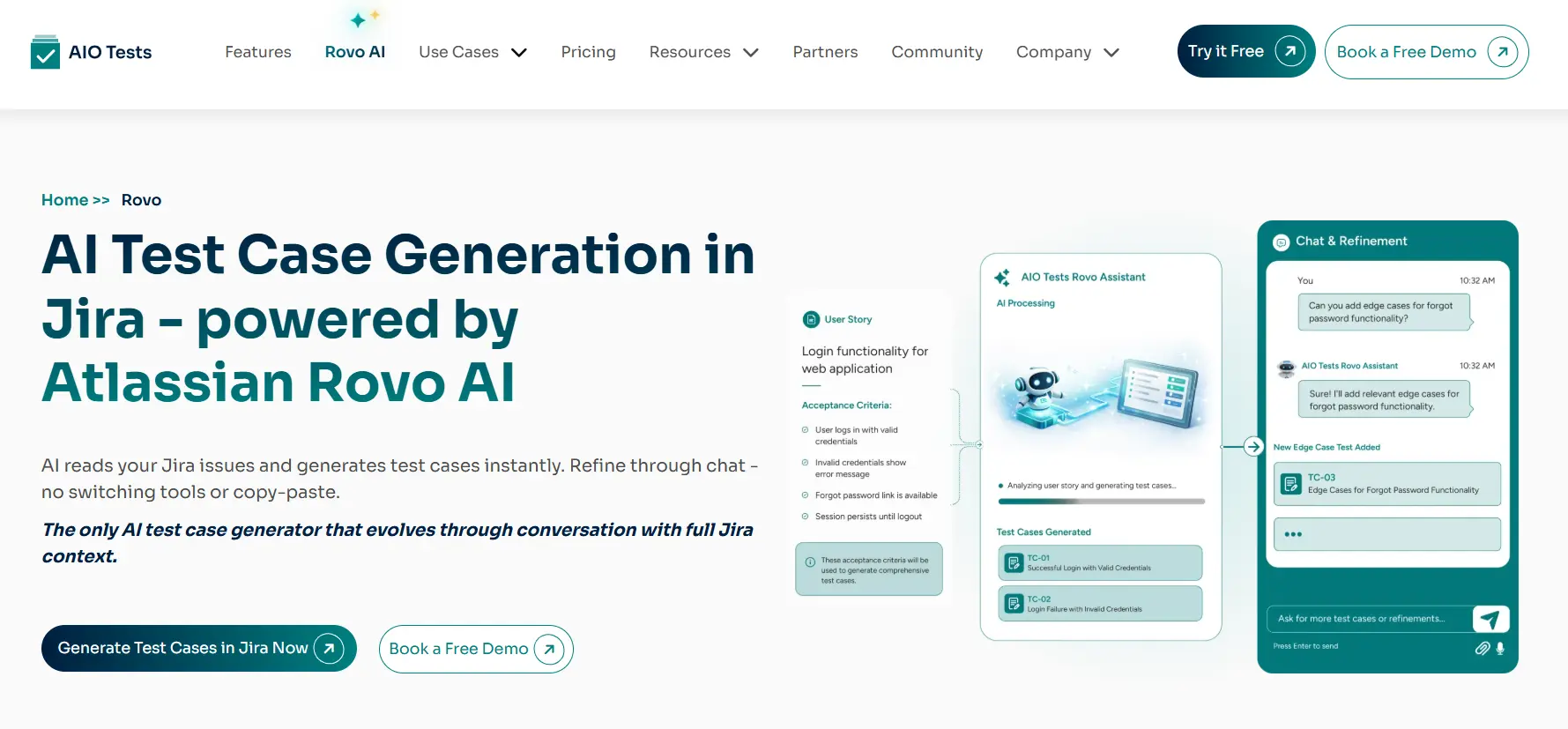
To make your workflow more efficient, try AIO Tests Rovo Assistant. The following are its core features that will blow your mind.
- Chat-Based Test Design
- Classic & BDD Formats
- Context-Aware Generation from Jira Issues
- Import to AIO Tests
AI agent automation represents a shift from static rule-based systems to adaptive intelligent agents that understand context and make decisions. Traditional automation follows fixed if-then logic. AI agents, however, adapt based on data, context, and evolving workflows.
Key differences include:
- Traditional automation: rigid and rule-based
- AI agents: adaptive and context-aware
Benefits of AI agent automation include:
- Dynamic workflow execution
- Context-aware decision-making
- Reduced dependency on manual intervention
For DevOps and Agile teams, this means faster iterations, fewer bottlenecks, and improved collaboration across development cycles.
Atlassian AI Agent and Enterprise Use Cases
An Atlassian AI agent extends automation capabilities to enterprise-scale workflows where complexity and coordination challenges are significantly higher.
In enterprise environments, these agents support:
- ITSM automation for faster incident resolution
- Engineering workflows for improved development efficiency
- Product operations for better alignment across teams
Enterprises adopt AI agents because they reduce operational friction and improve consistency across large-scale systems.
This allows organizations to scale productivity without a proportional increase in manual effort.
Challenges And Considerations Before Adopting AI Agents

Data Governance Risk
AI agents in enterprise environments rely heavily on access to structured and sensitive data. Without strong governance policies, organizations may face risks related to data privacy, compliance, and unauthorized usage. Clear controls and access policies are essential before deployment.
Workflow Design Dependency
AI agents perform best when workflows are well-structured and clearly defined. Poorly designed or inconsistent processes can limit their effectiveness and lead to unreliable automation outcomes. Organizations must standardize workflows to fully leverage AI-driven systems.
Adoption Learning Curve
Teams often need time to adjust to AI-driven systems, especially when shifting from rule-based automation. Understanding how to configure, monitor, and trust AI agents can take training and experience. Proper onboarding helps reduce resistance and improve adoption success.
Integration Complexity Issues
Integrating AI agents with existing tools such as Jira, Confluence, and third-party systems can pose technical challenges. Compatibility, data flow alignment, and system dependencies must be carefully managed. A phased integration approach helps minimize disruption and ensures stability.
Rovo Agent for Jira in Action (Real-World Use Cases)
The Rovo Agent for Jira becomes most powerful when applied to real-world scenarios.
Example use cases include:
- Bug triage automation: Automatically categorizing and prioritizing incoming issues
- Sprint reporting: Generating summaries of sprint progress without manual effort
- Incident response: Detecting and routing urgent issues to appropriate teams
The value delivered includes:
- Significant time savings across teams
- Reduced manual coordination and communication overhead
- Faster resolution cycles for critical tasks
This helps teams focus more on execution and less on administrative work.
Enterprise AI Agents And The Future Of Work
Enterprise AI agents represent a fundamental shift in how organizations approach digital work.
We are moving from static tools that require constant human input to autonomous agents that can operate with context and intent.
Key trends include:
- AI-first workflows becoming standard in enterprises
- Autonomous decision support systems replacing manual triage
- Smarter integration across tools like Jira, Confluence, and beyond
In the Jira ecosystem, this means workflows will become increasingly self-managing, adaptive, and intelligent over time.
Final Thoughts!
The evolution of Jira automation is clearly moving toward AI-driven systems that understand context, automate decisions, and reduce manual effort.
A rovo agent represents this shift in action, transforming how teams interact with Jira and manage workflows across projects.
As enterprises continue to adopt AI-powered tools, the future of work within Jira will become more autonomous, efficient, and intelligent, driven by continuous innovation in AI agents.
FAQs
- What is a Rovo Agent in Atlassian Jira?
A Rovo Agent in Jira is an AI-powered assistant that helps teams automate tasks, retrieve insights, and manage workflows more efficiently. It operates within the Atlassian ecosystem to support smarter, context-aware decision-making.
- How does Rovo AI improve Jira automation?
Rovo AI enhances Jira automation by introducing intelligence into workflows rather than relying solely on static rules. It helps teams analyze data, trigger actions, and streamline processes with greater accuracy and speed.
- Is Rovo Agent different from Jira AI assistant?
Yes, a Rovo Agent is a broader AI system that can perform actions and automate workflows, while a Jira AI assistant mainly focuses on helping users with Jira tasks. Rovo Agents are more autonomous and capability-driven.
- How does Rovo Agent work in enterprise workflows?
Rovo Agents work by analyzing Jira issues, project context, and workflow rules to automatically trigger actions. They can generate insights, update tasks, and route work based on real-time conditions.
- What are enterprise AI agents used for in Jira?
Enterprise AI agents in Jira are used to automate large-scale workflows, including IT service management, software development tracking, and project operations. They help organizations improve efficiency, scalability, and decision-making.


.svg)

