

.webp)
Summarize Blog
Quick Summary
AIO Tests helps Agile teams simplify regression testing by bringing test management, execution tracking, requirement traceability, and reporting into Jira. By replacing disconnected tools and manual reporting with a unified workflow, teams gain better visibility into coverage, testing progress, and release readiness.
Most QA leaders don't start looking for a regression testing platform because they need more test cases. They start looking because managing regression testing becomes harder with every release.
Test cases live across multiple systems. Coverage is difficult to verify. Release readiness depends on manual reporting. And every sprint requires additional coordination between QA, engineering, and product teams.
If your organization already uses Jira as its system of work, introducing another disconnected testing platform often creates more complexity instead of solving it. That's why many teams start looking for a test management app for Jira that supports regression testing without adding extra tools or processes.
That's why many Agile teams choose AIO Tests.
Rather than forcing QA teams into a separate workflow, AIO Tests brings test management, execution tracking, traceability, and reporting directly into Jira. In this guide, we'll look at how AIO Tests helps teams simplify the process while improving release confidence.
Why Existing Regression Testing Processes Stop Scaling
Most regression testing processes work well when applications are small and release cycles are predictable. Problems appear when teams scale.
A team managing 100 test cases can often rely on spreadsheets and manual coordination.
A team managing 2,000 test cases across multiple releases cannot.
As products grow, QA leaders face several operational challenges:
- Regression suites expand every sprint
- More teams contribute code
- More dependencies introduce risk
- Release frequency increases
- Stakeholders require greater visibility
- Test cases become scattered across multiple tools
- Regression suites become difficult to maintain
- Requirement traceability analysis becomes incomplete
- Manual reporting consumes valuable QA time
- Coverage visibility becomes limited
The testing itself may remain manageable, but the coordination becomes the bottleneck. QA managers spend time answering questions instead of improving quality:
- Which requirements have coverage?
- Which regression tests were executed?
- What remains untested?
- Is this release ready?
When those answers require manual investigation, release decisions slow down. At that point, the issue is no longer testing.
It's regression management.
What QA Leaders Should Evaluate Before Choosing a Regression Testing Tool
Before evaluating a qa regression testing tool, you should focus on capabilities that directly impact release confidence and operational efficiency.
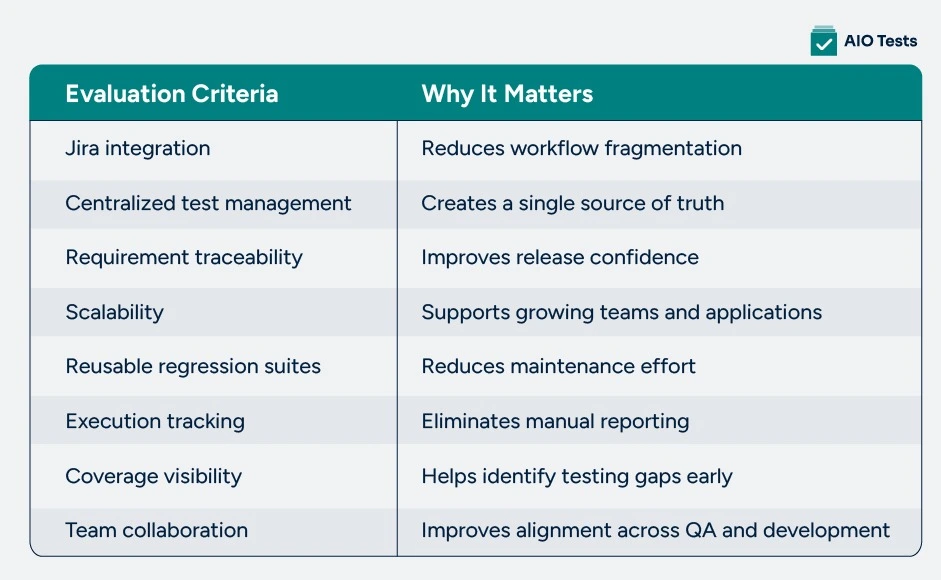
The goal is to find a qa testing tool that reduces operational overhead while improving release visibility.
How AIO Tests Simplifies Regression Testing in Agile
Jira-Native Test Management
Many testing tools require teams to leave Jira to manage testing activities. This creates workflow fragmentation and introduces additional administrative work.
AIO Tests operates directly within Jira, allowing teams to manage test cases, execution, and reporting alongside their existing development workflows.
Business Outcome: Less context switching and stronger collaboration between QA, engineering, and product teams.
Regression Suite Reuse
Regression suites should become more valuable over time. Instead, many teams spend effort recreating or reorganizing existing test assets.
AIO Tests helps teams organize and maintain reusable regression suites that can support multiple releases and testing cycles.
Business Outcome: Reduced maintenance effort and more consistent regression coverage.
Requirement Traceability
Release decisions depend on understanding what has been tested.
AIO Tests connects Jira requirements, stories, and test cases, making it easier to understand coverage relationships. This visibility helps teams identify gaps before release reviews begin.
Business Outcome: Faster release decisions and improved confidence in testing completeness.
Test Execution Tracking
Execution visibility is critical when multiple teams contribute to a release. AIO Tests allows teams to manage test execution progress directly within Jira. Stakeholders can monitor progress without relying on separate reporting systems.
Business Outcome: Reduced reporting overhead and improved testing transparency.
Reporting and Release Readiness
QA leaders need answers quickly.
- How much testing is complete?
- What remains outstanding?
- Where are the risks?
AIO Tests provides reporting capabilities that help teams track testing progress and evaluate release readiness more effectively.
Business Outcome: Better decisions based on current testing data.
Visibility Across Manual and Automated Testing
Most organizations use a combination of manual and automated testing. The challenge is maintaining visibility across both approaches.
AIO Tests provides a common test management layer that helps teams understand overall testing status within Jira.
Business Outcome: Improved visibility without fragmented reporting.
What a Typical Regression Cycle Looks Like in AIO Tests
Imagine a sprint nearing completion.
New stories have been developed, defects have been resolved, and the team is preparing for release.
Using AIO Tests, a QA lead can:
- Review completed Jira stories.
- Verify linked test coverage.
- Select relevant regression suites.
- Execute planned tests.
- Monitor execution progress.
- Review coverage and results.
- Assess release readiness.
Instead of collecting information from multiple systems, the testing workflow remains connected inside Jira. The outcome is faster decision-making.
AIO Tests vs Common Regression Testing Approaches
- Spreadsheets
Spreadsheets work initially. As regression suites grow, they become difficult to maintain, audit, and scale. Coverage visibility decreases while reporting effort increases.
- Standalone Test Management Tools
Standalone test management tools can provide strong testing capabilities. However, they often introduce workflow fragmentation when requirements and development activities remain in Jira. Teams spend additional time synchronizing information between systems.
- Jira-Native Workflow with AIO Tests
AIO Tests keeps requirements, test assets, execution, and reporting connected inside Jira. This reduces coordination overhead and improves visibility throughout the release lifecycle. For teams already invested in Jira, this alignment can significantly simplify regression management.
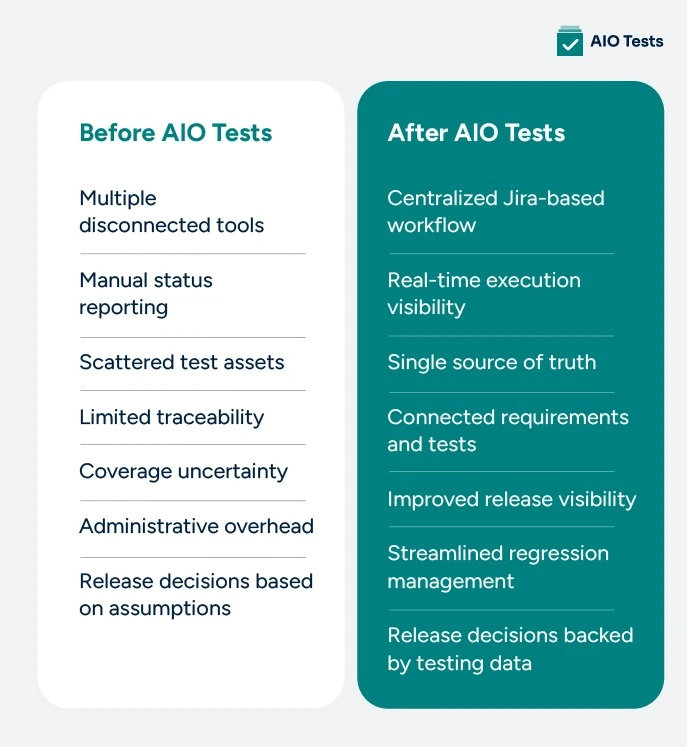
Before vs After AIO Tests
Who Should Choose AIO Tests?
AIO Tests Is a Strong Fit If:
- Your team works primarily in Jira
- Regression testing spans multiple sprints and releases
- Traceability is important for release governance
- QA reporting consumes significant time
- Stakeholders need better visibility into testing progress
- You want to reduce workflow fragmentation
AIO Tests May Not Be the Best Fit If:
- Your organization does not use Jira
- You require a standalone testing ecosystem
- Testing operates independently from development workflows
The best qa testing tool is one that aligns with how your teams already work.
Social Proof
AIO Tests is available through the Atlassian Marketplace and is used by organizations that manage testing within Jira-based development environments.
When evaluating any regression testing tool, review marketplace ratings, customer feedback, implementation requirements, and workflow fit alongside feature comparisons.
The strongest indicator of success is operational alignment with your existing software delivery process.
Stop Managing Regression Testing Across Multiple Tools
Regression testing becomes difficult when requirements, test cases, execution results, and reporting are disconnected. AIO Tests helps Agile teams bring those activities together inside Jira, improving visibility, traceability, and release confidence without forcing teams into a separate workflow.
See how AIO Tests can help your team simplify regression management and make faster, more informed release decisions.

Frequently Asked Questions
- Why choose a Jira-native regression testing tool?
A Jira-native regression testing tool keeps requirements, test cases, execution, and reporting connected within the same workflow. This reduces context switching and improves visibility.
- How does AIO Tests improve regression testing in Agile teams?
AIO Tests helps teams centralize test management, maintain traceability, track execution progress, and monitor coverage directly within Jira.
- What makes requirement traceability important for regression testing?
Traceability helps teams understand which requirements are covered and which may still pose release risk.
- Can AIO Tests support both manual and automated testing workflows?
Yes. Teams can manage testing activities and maintain visibility across both manual and automated testing efforts within a common workflow.
- How does AIO Tests help with release readiness reviews?
By connecting requirements, test execution, and reporting, AIO Tests gives stakeholders better visibility into testing progress and coverage before release decisions are made.


.svg)

