

Summarize Blog
Quick Summary
AI-based test automation helps Agile teams reduce regression failures by improving test stability, speeding up feedback, and minimizing maintenance. AI testing tools with features like self-healing tests and AI-generated test cases optimize testing workflows. Combining AI with traditional methods leads to faster, more reliable releases.
If you’re managing an Agile team, you’ve probably faced the frustration of dealing with flaky test results and tests that seem to break at the worst possible time.
As your codebase expands and releases speed up, traditional test automation often falls short. It’s a constant struggle: tests fail unpredictably, feedback takes too long, and maintaining scripts eats up valuable time.
That’s where AI-based test automation can make a real difference. AI helps teams focus on what matters: getting accurate results faster. Research has shown that AI tools can reduce regression failures by up to 30% and cut test execution time by 50%.
In this blog, we’ll explore how AI-based test automation can help Agile teams handle these challenges and prevent those dreaded regression failures that slow everything down.
What is AI-Based Test Automation?
AI-based test automation is a modern approach to testing that leverages artificial intelligence and machine learning to improve the efficiency, accuracy, and stability of automated testing processes.
Unlike traditional test automation that relies on rigid, predefined scripts to validate specific functionalities, AI in software testing uses intelligent algorithms that learn from past test results. This allows test automation to adapt dynamically to application changes without constant manual intervention.
Key differences between AI-based and traditional test automation:
- Traditional Test Automation: Uses static scripts that require frequent manual updates whenever code changes.
- AI-Based Test Automation: Automatically adjusts test scripts based on changes to the code, reducing the need for constant manual intervention.
Benefits of AI Test Automation
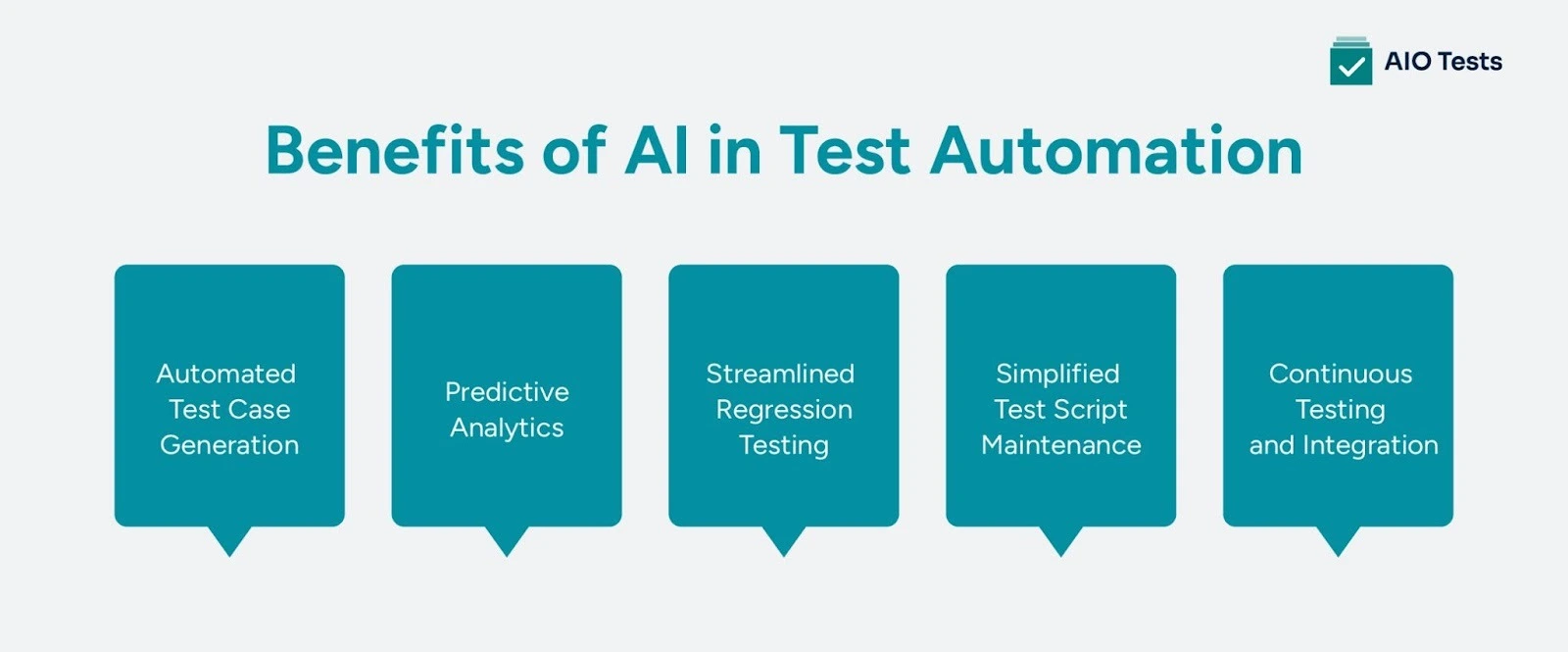
- Automated Test Case and Script Generation: In the manual vs automated testing comparison, test creation in manual workflows depends heavily on human effort and constant updates. AI test automation removes that friction by generating test cases and scripts from app behavior and past results.
- Predictive Defect Detection: By analyzing historical bugs and test data, AI highlights high-risk areas early, helping teams focus testing where failures are most likely.
- Optimized Regression Testing: AI streamlines regression testing by running only the tests impacted by recent changes, saving time while preserving release confidence.
- Self-Updating Test Scripts: Instead of constant manual fixes, AI automatically adapts test scripts as the application evolves, lowering maintenance overhead.
- Continuous Testing in CI/CD: AI-driven testing runs within the delivery pipeline, delivering rapid feedback that improves CI CD performance and supports faster, more stable Agile releases.
How AI-Based Test Automation Reduces Regression Failures in Agile Teams
Regression failures are a constant headache for Agile teams, especially during software regression testing. AI-based test automation tools provide a smarter, more adaptable way to prevent these issues before they impact release quality.
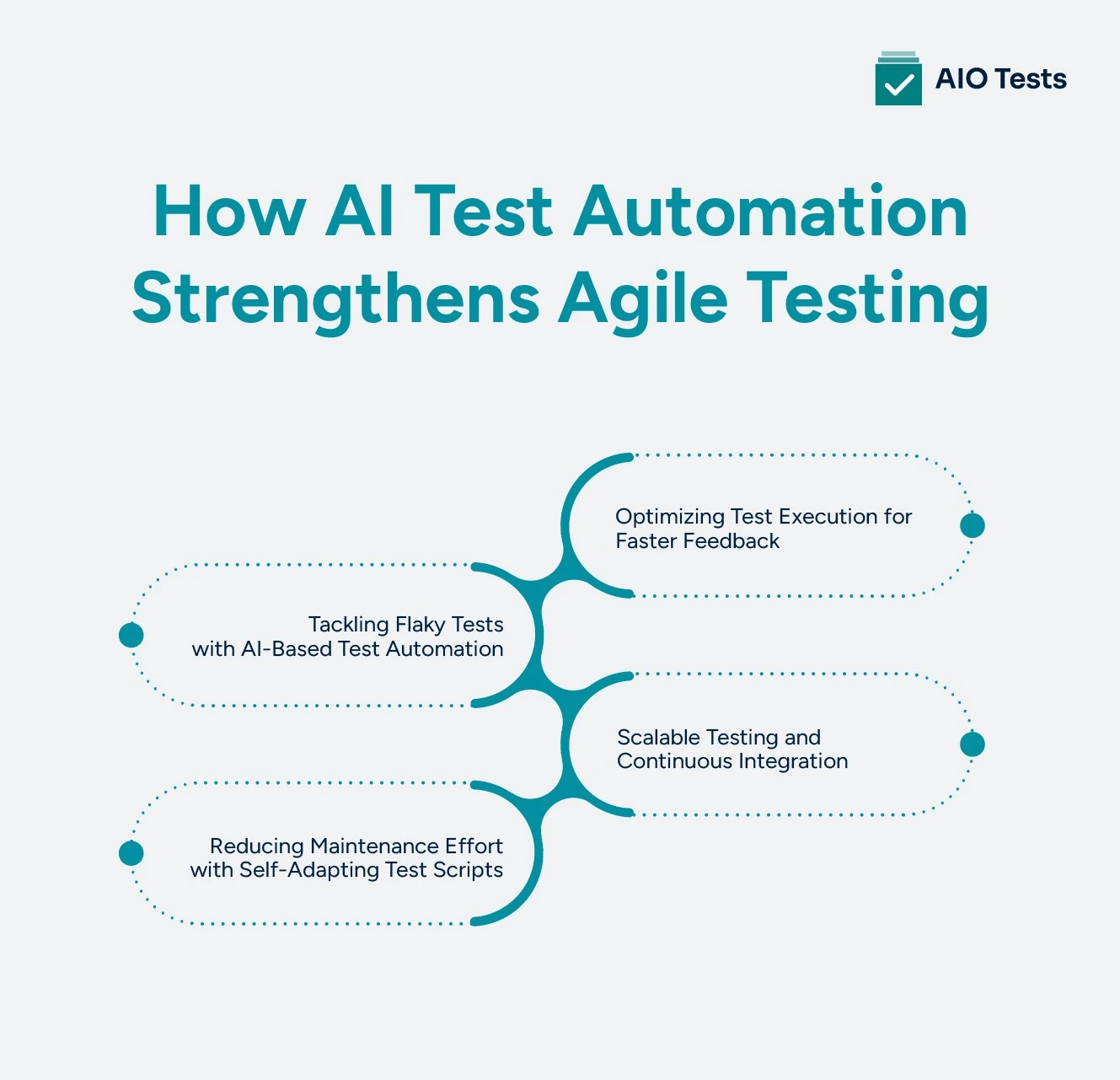
1. Tackling Flaky Tests with AI-Based Test Automation
Flaky tests are a significant pain point for Agile teams. These tests often pass or fail at random, making them unreliable and difficult to maintain. In AI-based test automation, flaky tests can be minimized by using intelligent tools that identify patterns in past failures and adjust test scripts accordingly.
- AI Test Automation Tools detect when test failures are caused by environmental issues or minor code changes, and not actual defects, ensuring that the tests provide more accurate results.
- Many AI-based test automation tools can automatically adjust or "heal" tests that fail due to minor code changes, which is a common issue in Agile environments. This significantly reduces the time spent on diagnosing false failures and provides more consistent test outcomes.
Example: An Agile team using an AI-powered test automation framework sees a dramatic decrease in flaky tests after switching to an AI-driven tool that learns from test patterns and adjusts test cases as the application evolves.
By leveraging these advanced test management tools, teams can reduce the frequency of unreliable test results, leading to fewer regression failures and more reliable feedback during each sprint.
2. Optimizing Test Execution for Faster Feedback
The faster a team can get feedback from tests, the faster they can fix issues and continue their work. AI-based test automation helps Agile teams optimize test execution by focusing on the most critical tests and eliminating unnecessary checks.
- AI Test Automation Frameworks: These frameworks prioritize test execution based on past data, risk factors, and the likelihood of failure. Tests that are more likely to catch critical issues are run first, while less relevant tests are deferred.
- Risk-Based Test Prioritization: By analyzing historical testing data and application changes, AI-driven testing tools can automatically prioritize tests that are most likely to detect regressions. This ensures that teams get faster feedback on their most important changes.
Example: An Agile team dealing with frequent regression failures adopts AI-based test automation tools to prioritize high-risk areas of their codebase. This allows them to catch potential bugs earlier and release features with confidence, drastically reducing the chances of undetected regressions.

3. Reducing Maintenance Effort with Self-Adapting Test Scripts
In traditional test automation, every time the codebase changes, automation scripts often need to be manually updated, which is a labor-intensive process. With AI-powered test automation, maintenance becomes far less burdensome.
- Automatic Script Updates: AI-based test automation tools can automatically adapt test scripts when changes are made to the application, reducing the need for constant manual updates.
- Self-Healing Capabilities: Many AI-driven testing tools come with self-healing features that automatically adjust test scripts when failures occur due to changes in the user interface, functionality, or underlying architecture.
Example: A large tech company adopting an AI-based test automation framework sees a reduction in time spent on test maintenance. AI tools identify when tests need to be updated based on application changes and update the scripts without manual intervention.
This means that less time is spent troubleshooting and updating tests, freeing up resources to focus on new features and improvements. In turn, this leads to a more efficient testing cycle and fewer regression failures.
4. Scalable Testing and Continuous Integration
As Agile teams scale and handle larger applications, testing needs to scale too. AI test automation tools manage this complexity by making testing more adaptable and scalable across different types of software testing, without increasing operational overhead.
- Scalability: AI-based test automation helps Agile teams scale their testing efforts without exponentially increasing the time and resources spent on manual maintenance. The AI system learns from each iteration, continuously improving its ability to handle larger and more complex test scenarios.
- Continuous Integration: With AI-driven testing tools, teams can ensure that tests are integrated seamlessly into their continuous integration (CI) pipeline. This allows for rapid, automated testing of every code change, helping to catch regression failures early.
Example: A fast-growing SaaS company implements AI-powered test automation within its CI pipeline. This ensures that every code change is automatically tested for regressions, significantly reducing the chances of introducing bugs into production.
By leveraging AI-based test automation tools that scale with the product, teams can reduce the impact of regressions on fast-moving development cycles.
Which AI Test Automation Tools Should You Explore?
Below is an overview of some of the top AI-powered test automation tools currently on the market, as well as frameworks that can help improve test stability and reduce regression failures.
1. Testim
- Category: AI Test Automation
- Key Benefit: Self-healing capabilities for stable tests.
Testim is an AI-powered test automation tool that focuses on self-healing test scripts. The tool automatically detects and adjusts tests when the application changes, reducing time and effort spent on script maintenance. This feature helps minimize the risk of flaky tests, a major contributor to regression failures.
2. Applitools
- Category: Visual AI Test Automation
- Key Benefit: Visual AI that detects UI regressions.
Applitools specializes in visual testing, using AI to compare the UI of an application with a baseline to identify visual regressions. This tool is incredibly useful for teams focused on ensuring that UI elements remain consistent after updates or changes.
Complementary Management for AI Automation: AIO Tests
While Testim and Applitools offer robust AI-driven capabilities for test automation, AIO Tests provides a complementary management layer that integrates seamlessly with these AI tools.
AIO Tests doesn’t perform the test execution itself, but leverages AI features to streamline test management.
What AIO Tests Brings to the Table:
- AI-Generated Test Cases: AIO Tests uses Generative AI to create both classic and BDD-style test cases, helping teams quickly expand their test suites without manually writing each test case.
- Automation Result Import: AIO Tests integrates results from popular test automation frameworks like TestNG, JUnit, and Cucumber directly into Jira test cycles, making it easy to track and manage testing results in one central location.
- Unified Regression Tracking: By consolidating test results from multiple sources, AIO Tests enables Agile teams to have a unified view of their regression testing status, even when using multiple AI-powered tools.
Key Benefit of AIO Tests: It enhances the testing workflow by managing and tracking results across different automation tools, providing a clearer picture of test coverage and stability.
- Pros:
- Seamless CI/CD pipeline integration with Jenkins/GitHub
- Manages AI-generated test cases in native Jira cycles
- Team-wide visibility into regression results via 20+ QA testing reports
- Cons:
- AIO Tests doesn’t handle test execution, meaning teams still need a separate AI-powered testing tool for the actual execution.
- Test management focus, not direct test failure resolution

Conclusion
AI-based test automation offers significant benefits, but it’s important to understand that it’s a tool.
To effectively reduce regression failures, AI must be thoughtfully integrated into your testing workflows, complementing traditional methods. Combining AI-driven testing with manual and exploratory testing ensures a well-rounded approach, leveraging the strengths of both.
This balance helps teams reduce maintenance overhead, optimize feedback loops, and improve overall test stability. To explore how AIO Tests can enhance your testing strategy with AI-driven test case generation and result management, book a demo today and see it in action.

FAQs
- How is AI used in test automation?
AI is used in test automation to improve test stability, reduce manual effort, and automate tasks like test case generation and maintenance. AI tools can identify patterns, adapt to code changes, and optimize test execution, helping to reduce regression failures in Agile workflows.
- Which is the best AI tool for testing?
The best AI tool depends on your needs, but AIO Tests stands out for its AI-based test case generation and integration with test automation results in Jira. It complements tools like Testim and Applitools by offering seamless test management without running tests directly.
- What are the benefits of using AI-based test automation tools?
AI-based tools help reduce test maintenance, identify high-risk areas for testing, and improve test accuracy. They speed up the feedback loop and ensure more reliable test results, reducing the chances of regression failures in Agile teams.
- Can AI test automation replace manual testing?
No, AI tools complement manual testing by automating repetitive tasks, but do not replace the need for human testers. Manual testing is still crucial for exploratory testing and validating complex business logic.


.svg)

