

.webp)
Summarize Blog
Quick Summary
AI-generated test cases cut creation time by up to 80%, but Jira-native QA teams need a solution that fits their existing workflow, not one that adds a new tool.
Your sprint starts Monday. By Wednesday, developers have pushed 40 new user stories into Jira. By Thursday, your QA team is still writing test cases manually for the first fifteen. Friday's release is not waiting.
This is the real pressure QA Leads face inside Jira-native teams. The debate about AI-generated test cases vs. manual test design has been running for two years, and most articles give the same answer: "use both." That is not a decision. That is a dodge.
This article provides a direct breakdown of what each approach delivers, where each falls short, and what the right answer looks like for a team that plans, builds, and tests in Jira.
What AI Test Case Generation Actually Does (and What It Does Not)
AI test case generation reads your requirements, user stories, and acceptance criteria, then identifies test scenarios across the full spectrum: happy paths, negative cases, boundary conditions, and edge cases. It outputs structured test cases in a classic step-by-step format or a BDD/Gherkin format, depending on your automation framework's needs.
What AI test case generation does not do is equally important to understand.
It cannot read your team's unwritten institutional knowledge. It does not know that your payment module has a known fragility under concurrent sessions, or that your legacy API behaves differently on the third Tuesday of the month.
It cannot replicate the intuition a senior QA Lead builds over years of watching a specific system break in specific ways. It will not catch what it was not trained to look for.
AI generates the structure. Humans validate the judgment. Both are necessary, but they are not interchangeable.
What Manual Test Design Still Gets Right That AI Cannot Replace?
Manual test design is not slower because testers are less efficient. It is slower because it requires the kind of thinking that AI cannot currently do. Here is where that thinking still matters.
1. Exploratory Testing Intuition
Exploratory testing is the clearest example. When a tester investigates unknown system behavior, they follow a hunch. They click the thing that does not look right. They notice that a field accepts more characters than it should. AI does not follow hunches. It generates what the requirements say should be tested, not what a human would notice is wrong. Manual wins here, no contest.
2. Complex Logic Expertise
Complex business logic is the second scenario. Regulated workflows, financial calculations, and multi-step interdependencies with conditional logic require domain expertise that lives in the QA Lead's head, not in a requirements document. When the stakes are high and the logic is intricate, AI-generated test cases require so much review and correction that the time savings disappear.
3. Ambiguous Requirement Gaps
Ambiguous or incomplete Jira tickets are the third scenario. When a user story says "user can update profile" with no acceptance criteria, a human tester draws on experience to determine what "update profile" actually implies. AI generates something generic and often misses the real risk. Garbage in, garbage out applies here more than anywhere else.
4. Early Product Volatility
Early-stage product development is the fourth scenario. When requirements change every sprint, building AI-generated test suites creates maintenance debt faster than it creates value. Manual testing adapts in real time. AI test suites need to be regenerated or updated whenever the spec changes.
AI Generated Test Cases vs Manual Test Design: A Direct Comparison
No competitor article in this space has published a direct comparison table. Here it is.
The Jira workflow fit row is the one that no other comparison includes. For QA Leads who manage testing inside Jira, it is the row that matters most. An AI tool that generates test cases outside Jira forces you to manually re-link those cases to your Jira issues. That step kills the traceability that makes Jira useful in the first place.
How Automated Test Case Generation Works Inside a Jira-Native Workflow?
Isolated Tool Limitations
Most QA Leads evaluating automated test case generation run into the same problem. The AI tool they are looking at works well in isolation. It generates structured test cases quickly. The output is usable. But it lives outside Jira, which means the test cases it produces are disconnected from the requirements they are supposed to cover.
Export Import Overhead
The export-import cycle that follows is not a minor inconvenience. You export test cases from the test management AI tool, import them into your test management system, and then manually link each case to the originating Jira issue. For forty user stories, that workflow adds hours. It also creates a synchronization problem: when the Jira issue is updated, the linked test case does not update automatically.
Jira Native Integration
Jira-native AI test generation solves this at the architecture level. The AI reads directly from the Jira issue. The test cases it generates are immediately linked to that issue. Everything stays inside Jira, within your existing permission structure and traceability chain. There is no export, no import, no manual re-linking.
Traceability And Control
Why tool architecture matters here is not a technical detail. It is a workflow decision. A Jira-native AI tool is not just faster. It preserves the audit trail that connects requirements to test coverage to defects to release decisions. That chain is what gives QA Leads the visibility they need to sign off on a release with confidence.
How AIO Tests Rovo Assistant Handles AI Powered Test Case Creation Directly Inside Jira?
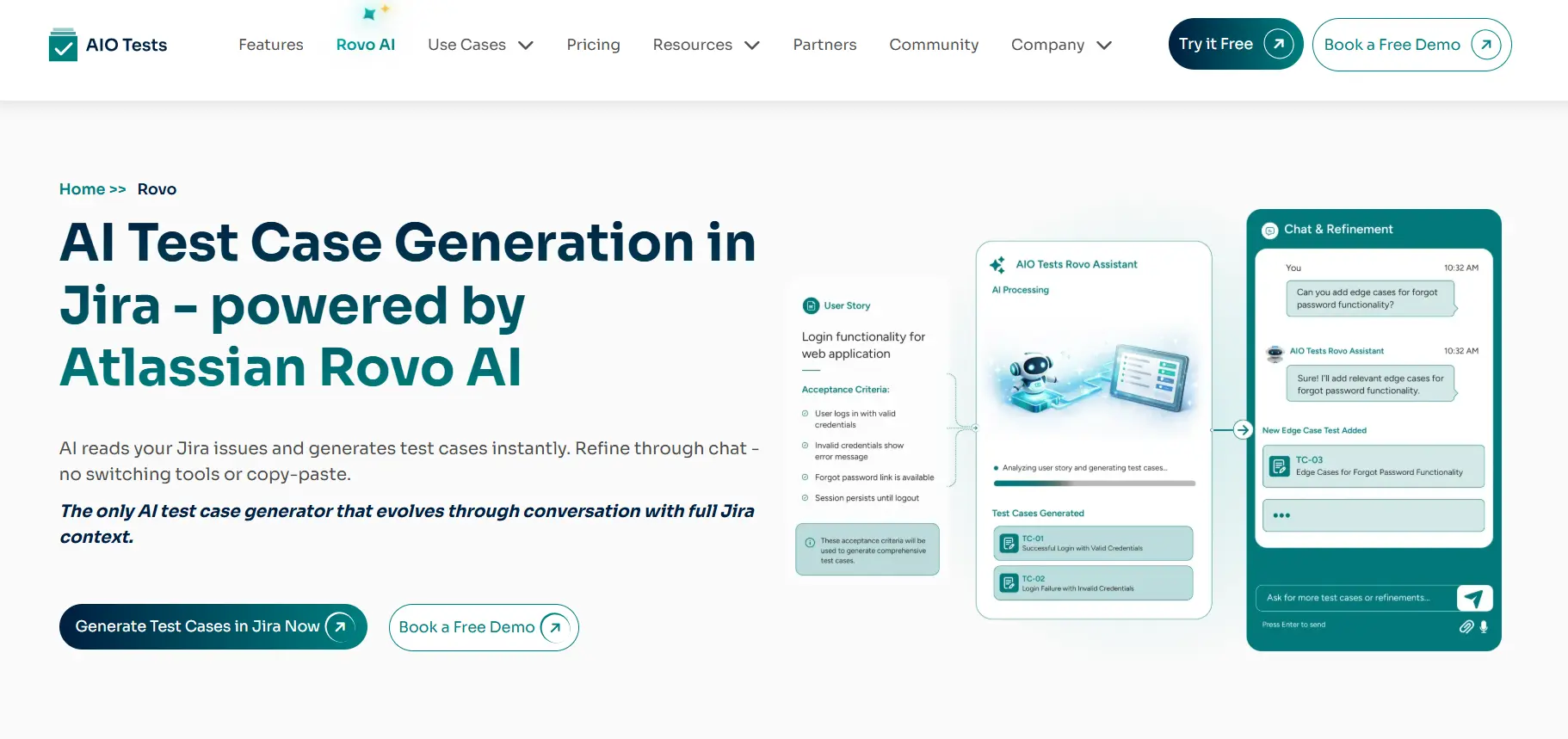
Modern QA teams don’t need another standalone AI tool; they need intelligence that lives where their work already happens.
AIO Tests Rovo Assistant is built directly into Jira, so test case creation occurs within the same flow as planning and development. No context switching, no duplicate tools, no broken traceability chains. It turns every user story into structured, review-ready test coverage in minutes.
Core Features of AIO Tests Rovo Assistant
1. Chat-Based Test Design
AIO Tests Rovo Assistant enables QA teams to refine test cases through a simple chat interface inside Jira. Instead of restarting generation or rewriting prompts, you can ask for more scenarios, adjust edge cases, or improve clarity in real time. This keeps test design iterative, fast, and aligned with evolving user stories.
2. Classic & BDD Formats
The assistant supports both traditional step-by-step test cases and BDD/Gherkin formats, making it flexible for any QA or automation stack. Whether your team uses Cucumber, Playwright, or TestNG, you can generate ready-to-use scenarios without manual conversion. This reduces formatting effort and accelerates automation readiness.
3. Context-Aware Generation from Jira Issues
AIO Tests Rovo Assistant reads directly from Jira user stories, including summaries, descriptions, and acceptance criteria. It also analyzes linked and related issues to understand broader feature context, not just isolated tickets. This results in richer coverage and fewer missed edge cases.
4. Import to AIO Tests
Once generated, test cases are seamlessly imported into AIO Tests, preserving full requirement-to-test traceability within Jira. There is no copy-paste or manual mapping required, which eliminates common workflow friction. Every test remains connected to its source story for complete audit visibility.

Test Case Generation Using AI: When It Delivers Real Value and When It Does Not
Most articles on this topic avoid giving a direct answer on when to use which approach. Here is the direct answer.
Use AI test case generation when:
- Your Jira user stories have clearly written acceptance criteria. The AI reads what is there. If acceptance criteria are detailed, output quality is high.
- You are covering high-volume regression scenarios across sprints. AI handles volume faster than any manual team can.
- Your team needs BDD/Gherkin output, and your testers should not be spending time on format conversion.
- Your release cycle is too fast for manual test design to keep pace with development velocity.
Keep manual test design when:
- Requirements are in flux or incomplete. AI generates based on what is written. When what is written changes every week, AI output requires constant regeneration.
- You are testing complex domain-specific workflows where institutional knowledge is the differentiator between a test that catches a real defect and one that misses it.
- You are running exploratory sessions to investigate unknown system behavior. This is human territory.
- You are validating regulatory compliance, in which every test case must be explicitly reasoned and traceable to a specific regulation.
Most modern Jira teams do not choose one. They use AI for volume coverage and manual for critical paths. The real question is which tool lets you do both without leaving Jira.
AI Generated Test Cases for Software Testing: What Modern Teams Are Actually Doing
Industry Adoption Data
The data on adoption is now clear enough to cite directly. The World Quality Report 2024 by Capgemini found that 68% of organizations are using or planning generative AI in quality engineering. That is not a future prediction. It is a current baseline.
Measurable Efficiency Gains
An AWS case study on generative AI in software engineering documented reductions in test case creation time of up to 80% in automotive software environments. The full study is published on the AWS Industries blog and is linkable for reference.
Hybrid Testing Strategy
The pattern across high-adoption teams is consistent. They use AI for sprint-level regression coverage: the test cases that must exist for every regression cycle and are updated each sprint as features change. They reserve manual design for complex feature validation, critical-path user journeys, and any scenario in which the tester's judgment is irreplaceable.
Traceability Adoption Barrier
For Jira-native teams specifically, the adoption blocker is rarely willingness. Teams want to adopt AI test generation. The blocker is traceability. When AI-generated test cases cannot be automatically linked to Jira requirements, teams revert to manual processes because they cannot afford to lose the audit trail.
Software Test Case Generation: The Hybrid Approach That Works Sprint After Sprint
The debate is not AI vs manual. The right question is which testing scenarios belong to which method, decided once per sprint type rather than argued team-wide every quarter.
Here is the sprint-level decision framework that modern QA teams are running:
- New feature with complete user stories: start with AI, review output, add manual edge cases for known risk areas
- Regression coverage across unchanged modules: AI handles entirely, no manual review required unless coverage drops below the threshold
- Critical-path user journeys with business logic: manual design, AI can suggest an initial structure that the QA Lead then refines
- Exploratory sessions: manual only, no AI involvement
- BDD scenarios for CI/CD pipelines: AI generates, QA Lead reviews and approves before committing to the test suite
Final Words!
AI-generated test cases win on speed, volume, and regression coverage. Manual test design wins on judgment, domain knowledge, and exploratory quality. Both statements are true, and neither one is a reason to pick only one approach.
For QA Leads managing testing inside Jira, the real differentiator is not the method. It is the tool. A tool that keeps AI-generated test cases linked to your Jira requirements, within your Jira permissions, and within your existing traceability chain removes the only real blocker to AI adoption at scale.
The teams shipping faster in 2026 are not the ones that chose AI over manual work. They are the ones who found a way to run both inside the same workflow without breaking the audit trail that their stakeholders depend on.

FAQs
- Can AI generated test cases replace manual testing entirely?
No. AI-generated test cases cover high-volume, well-defined scenarios efficiently, but they cannot replicate human judgment in exploratory testing, complex business logic validation, or ambiguous requirements. The strongest QA teams use AI for coverage volume and manual design for critical paths where expertise matters.
- How does AI test case generation work with Jira user stories?
Jira-native AI tools read the summary and description of a Jira user story directly and generate structured test cases linked to that issue. The quality of the output depends on how clearly the user story and acceptance criteria are written. Well-documented Jira tickets produce high-quality, usable test cases with minimal review required.
- What is the difference between AI generated test cases and automated test execution?
AI-generated test cases are written scenarios that define what should be tested and how. Automated test execution is the process of running test scenarios using a framework such as Selenium, Playwright, or Cypress without human intervention. You can have AI-generated test cases that are executed manually, and you can have manually written test cases that run in an automated pipeline. They are separate stages of the testing process.
- Is AI test case generation reliable enough for regression testing?
Yes, regression testing is where AI test case generation delivers the most consistent value. Regression scenarios are well-defined, repeat across sprints, and require volume coverage rather than nuanced judgment. An AWS case study documented up to 80% reduction in test case creation time for this type of scenario. The key is to ensure that generated cases are reviewed once and stored in a system that links them to their originating requirements.
- Which teams benefit most from AI-powered test case creation?
Jira-native QA teams working in fast sprint cycles benefit most, specifically teams where manual test case writing creates a bottleneck between development velocity and release readiness. Teams with clearly documented user stories and acceptance criteria in Jira see the highest output quality. Teams in regulated industries or with highly complex domain logic see lower immediate returns and typically use AI for lower-risk coverage while keeping manual design for critical scenarios.


.svg)

